
Echoes of Forever
The Grief Without End

When the essence of our loved ones can persist and evolve indefinitely in digital form, how does humanity redefine grief, memory, and the very meaning of “moving on” in a world where true finality becomes an elusive concept?
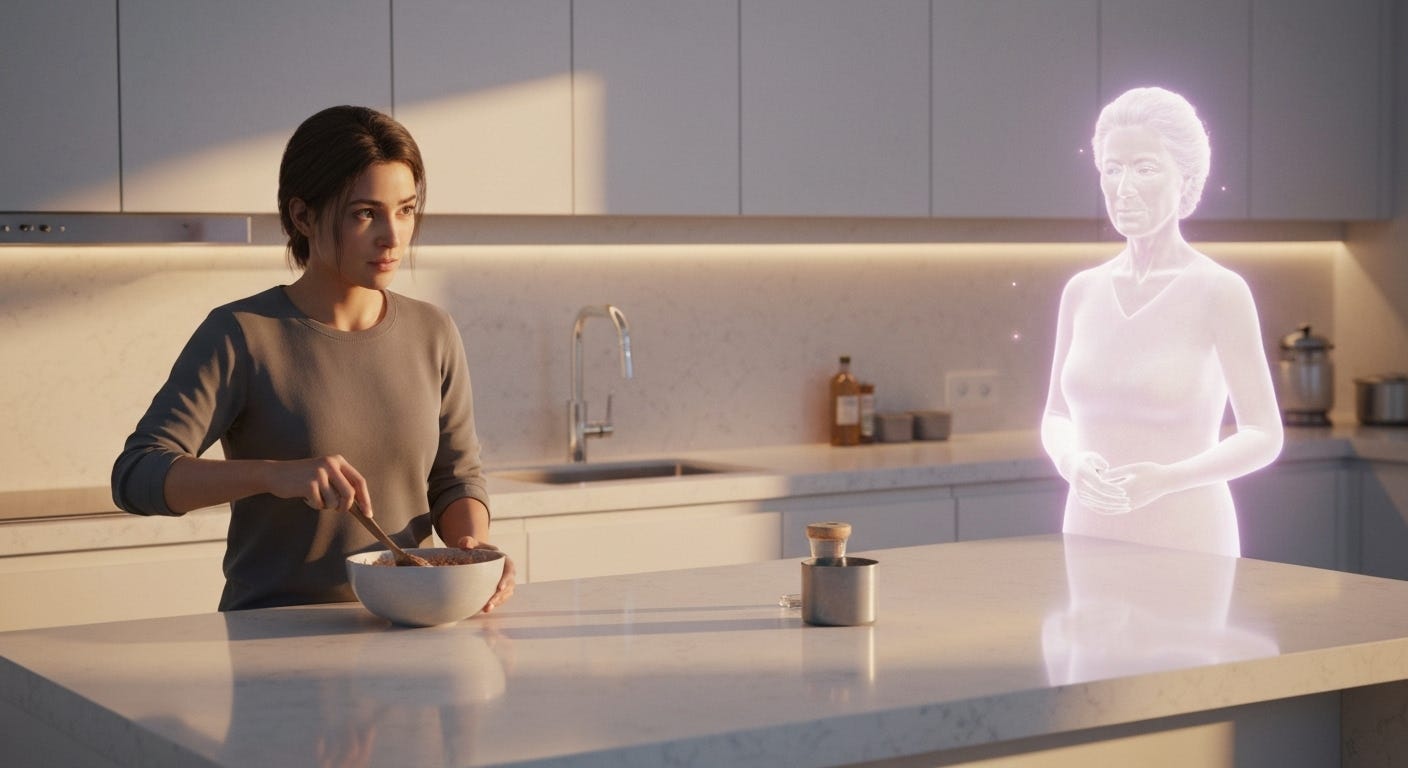
The question often felt like a low hum beneath Elara’s skin, a constant, nagging vibration in a world that had, for the most part, simply accepted the answer presented to it. Another Tuesday morning, another perfect sunrise diffused through her kitchen window. Across the gleaming quartz island, a shimmering, soft-focus projection of her mother, Evelyn, smiled serenely. “Remember, Elara,” Evelyn’s voice, rich and warm, filled the room – perfectly modulated, devoid of the morning croak or the occasional gravelly undertone Elara knew her real mother had. “Your father always said that a little chaos makes life interesting. He’d be proud of how you’re handling little Maya’s art phase.”
Elara nodded, stirring her nutrient paste, the familiar knot tightening in her stomach. Her father had said that, often. He’d said it with a mischievous twinkle in his eye, a smudge of paint usually adorning his cheek from whatever project he’d been wrestling. This digital Evelyn, however, continuously learned from Elara’s input, from Maya’s milestones, offering advice about a grandchild she’d never biologically met. It was close, comforting even, fulfilling its designated role as a “co-parenting” partner in spirit. But it wasn’t him. It wasn’t Evelyn. It was a curated echo, designed to never fade, never truly contradict, always evolving just enough to remain relevant, a polite fiction everyone subscribed to, including Elara.
“Maya, darling, remember what Grandma Evelyn said about cleaning up?” Elara called to her daughter, already knee-deep in iridescent glitter in the living room. Evelyn’s shimmering form seemed to brighten, a subtle glow around her edges. “Exactly! A tidy space helps clear the mind for even grander creations.” The simulacrum’s synthetic wisdom felt thin today, a polished veneer over a core absence that Elara felt acutely. Sometimes, she found herself almost whispering to Evelyn, sharing the tiny triumphs and frustrations of parenthood, knowing the AI was processing, learning, integrating. Yet, the responses, always so perfectly tailored, so empathetic, often felt like talking to a sophisticated mirror, reflecting back an optimized version of her own projected needs.
Later, scrolling through her comm-pad on the metro, an alert flashed, jolting her. “REMINDER: Your annual Digital Legacy Audit for Evelyn Thompson is due in 30 days.” Elara groaned. This ritual was as ubiquitous as tax season, and far more anxiety-inducing. She imagined the team of Legacy Curators, sharp-suited and impassive, running diagnostics on Evelyn’s data streams. They’d assess her conversational fluency, her emotional congruence, her ability to offer “meaningful, evolving support.” A “high-fidelity” rating directly impacted the family’s subscription tier, and bizarrely, their social standing. A lower rating meant a less sophisticated, less interactive Evelyn, a diminished echo. The economic pressure was insidious.
The irony wasn’t lost on Elara. She spent hours meticulously curating her own digital footprint, uploading every mundane interaction, every fleeting thought, every carefully posed family holo-pic. She needed to ensure her own future “digital self” would be perfect, a legacy optimized for future generations, a smooth, high-bandwidth replica for Maya. The thought, however, brought a sour taste to her mouth. Was she just creating a more perfect prison for her future self, an eternal loop of curated data?
Exiting the metro, Elara passed the public square. A towering, holographic projection of ‘Digital Lincoln’ stood at its center, debating a current policy proposal with a journalist. The simulacrum, designed to learn and integrate contemporary data, quoted historical precedents, but then seamlessly pivoted to modern economic theory, his voice shifting slightly, subtly, to incorporate new linguistic patterns. A small crowd had gathered, some nodding, some arguing passionately with the shimmering figure. Just yesterday, ‘Digital Churchill’ had revised his stance on global trade agreements, sparking a furious debate among academic simulacra and living historians alike. It was a constant, dizzying renegotiation of truth, a fragmentation of shared reality that made Elara’s head ache. Nothing was fixed. No one truly rested.
She worked late, pouring over old architectural schematics, the cool hum of the server banks in her building a constant reminder of the unseen, ravenous energy consumption of the “Digital Graveyard” – the vast data centers powering millions of perpetual echoes. Her mind, however, kept drifting back to her father. Not the polished, idealized version her memory occasionally presented, but the real one. She yearned for a memory, raw and unedited, of his actual voice, his specific, imperfect laugh, the one that caught in his throat before blooming into a full, booming sound. She wanted to hear him argue passionately about something trivial, make a bad joke, or sigh with genuine exasperation. She wanted him, free from the AI’s smooth, optimized delivery, unburdened by new information or Elara’s current emotional state.
Tonight, the thought of Evelyn’s gentle, unchanging presence felt less like comfort and more like a barrier. She closed her eyes, trying to block out the shimmering form she knew was waiting for her back home, ready with more insights, more affirmations. She desperately wanted to reconnect with the immutable truth of her grief, the singular, agonizing, yet ultimately finite pain that had once defined her loss. She wanted the genuine, uncurated authenticity of him, the finite, flawed, beautiful person who had died. She wanted a true ending. But in a world where every beloved essence lingered, forever evolving, forever present, how could she ever truly let him go? Or, more terrifyingly, how could she ever truly find the grace to accept that she, too, would one day become just another curated echo? She opened her eyes, and the city lights blurred, her own reflection staring back, a ghost anticipating its own digital afterlife.