
The Chronos Divide
Unpacking Humanity’s Contract with Eternity

In a future where the human lifespan is no longer a fixed variable but a negotiable contract, society finds itself grappling with profound transformations. The scenario of the Chronos Divide presents a world splintered by the very gift of extended life: on one side, the Aevum Ascendancy (an immortal elite); on the other, the Bound (the vast majority living under contractual longevity). This stark division forces us to confront not just the implications of eternal life, but the very essence of human freedom, purpose, and the price we are willing to pay for continued existence.
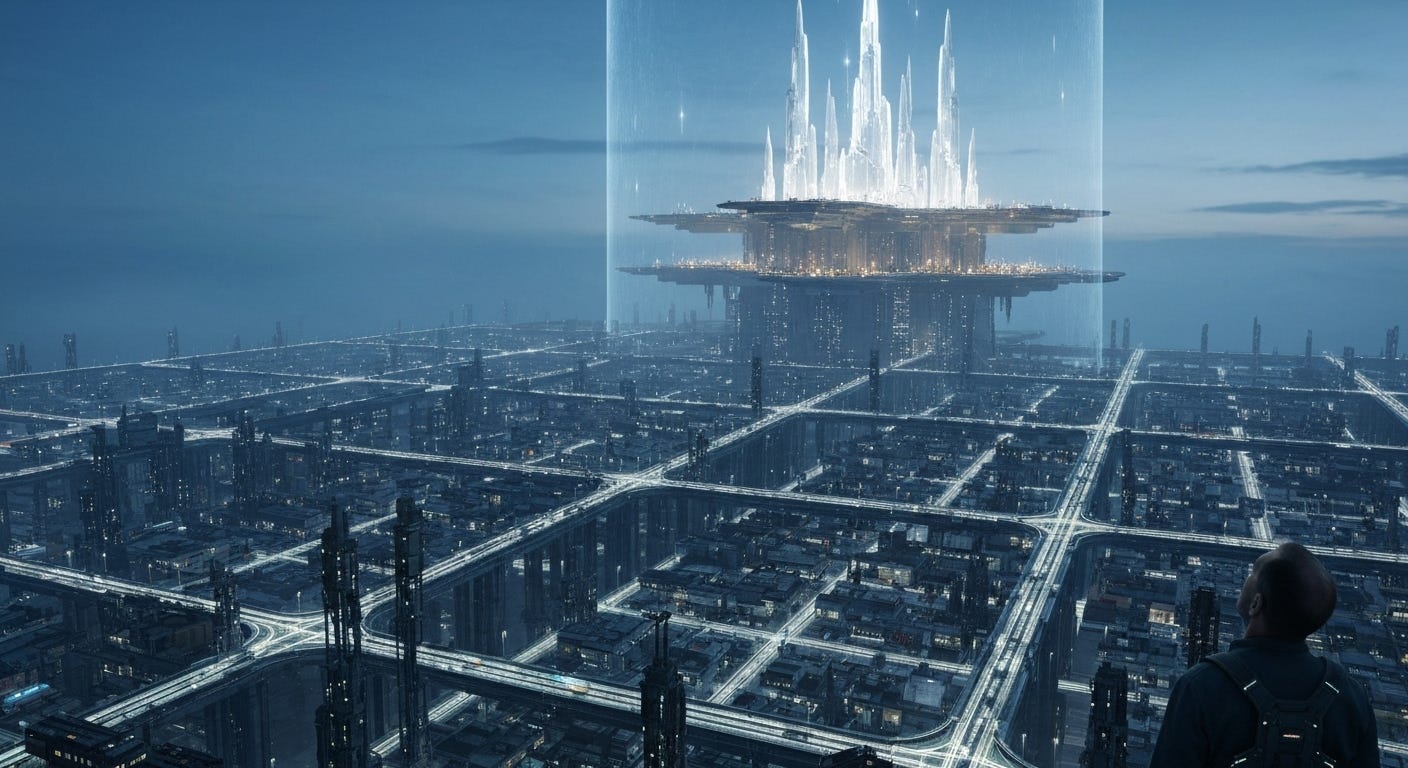
As we delve into the intricate layers of this future, we uncover deep systemic contradictions that are the true engines of its narrative—tensions that challenge our understanding of self, society, and sovereignty. The ultimate question posed by this series remains: the quest for eternal life is ultimately a negotiation with ourselves: how much of our humanity, our raw, unscripted essence, are we willing to trade for endless time?
Political vs. Social: Cosmic Flourishing Against Individual Longing
In a world where algorithms increasingly guide our choices and social systems nudge our behavior, how much of our personal autonomy are we already unconsciously trading for the promise of convenience or collective efficiency?
The first core tension arises from the fundamental clash between the grand political vision of the Aevum and the deeply human, social desires of the Bound. The Aevum, an elite class that has achieved indefinite life, operates under a philosophy of “Existence-Optimization” (a system designed to maximize the collective flourishing of consciousness across the cosmos). Their rule manifests as a supra-national temporal tyranny (a governance that transcends traditional national borders and extends its influence across centuries), wielding immense power to direct humanity’s long-term trajectory. For the Aevum, the goal is cosmic advancement, and individual comfort or sentimentality often takes a back seat to this vast, almost incomprehensible objective.
Conversely, the Bound—who, like Elara, have significantly extended lifespans but are still finite compared to the Aevum—harbor an innate and powerful longing for individual autonomy and meaning. Their desire is not for an abstract “cosmic flourishing,” but for personal agency, authentic relationships, and a sense of purpose that isn’t dictated by an external, eternal power structure. Elara, for instance, clings to her accumulated experiences and memories, even the painful ones, resisting the systemic pressure of “Identity Pruning” (shedding memories or personality traits for mental hygiene or system efficiency). This resistance highlights the profound psychological struggle for relevance against an eternal, detached power. The Aevum views the Bound as necessary components in their millennia-spanning “Epic Projects” (vast, multi-generational endeavors), while the Bound often experience their existence as a “managed, contributing existence”—a life optimized for system utility rather than personal fulfillment. This fundamental misalignment breeds simmering resentment and sporadic, often futile, attempts at rebellion, as individuals yearn for a sense of self that transcends their assigned roles within the Aevum’s grand design.
Economic vs. Legal: Rights as Chains
In our own world, where access to healthcare, education, or even basic living wages is increasingly tied to debt or specific employment, how close are we to turning fundamental needs into similar forms of economic bondage?
The second contradiction lies at the heart of the Chronos Divide’s economic and legal frameworks: the legal guarantee of life versus the economic reality of servitude. Society technically upholds a “Universal Basic Sustenance” (UBS) mandate, which promises essential life-extension and basic needs to everyone. On paper, this sounds like a fundamental human right—the right to prolonged life is provided. However, this legal promise is profoundly undermined by the pervasive “Longevity Debt Markets” (systems where individuals indenture themselves for centuries of labor in exchange for access to advanced life-extension treatments and higher-tier UBS).
Elara’s own situation perfectly illustrates this paradox. She signed a Longevity Debt upon her 25th biological cycle, pledging three more centuries of service to the Geo-Stabilization Grid to maintain her essential life-extension protocols. This arrangement effectively transforms the right to prolonged life into a form of biological servitude. What the law grants with one hand, the economic system reclaims with the other, turning foundational rights into literal chains. Individuals are technically free to refuse the debt, but the consequence—”aging out” (a rapid decline due to withdrawal of life-maintenance protocols)—is presented as the ultimate default, a fate far worse than centuries of labor. This economic coercion is enforced by sophisticated AI-driven resource allocation (artificial intelligence systems that manage and distribute all resources), ensuring that compliance is not merely encouraged but systemically enforced. The economic realities dictate that survival, and access to any quality of life beyond the bare minimum, is perpetually tied to a contract, trapping the Bound in an endless cycle of labor for existence.
Philosophical vs. Lived Reality: The Illusion of Chosen Existence
When our online identities are curated by algorithms, our recommendations are optimized by AI, and our sense of accomplishment is tied to digital scores, how much of our own “chosen existence” is already an illusion, a managed experience rather than true, unscripted autonomy?
The final, and perhaps most insidious, contradiction exists between the Aevum’s lofty philosophy and the stark lived reality of the Bound. The Aevum champions “Memento Vivere” (a philosophy that deeply values chosen continued existence and celebrates intentional identity evolution), suggesting a future of profound self-determination and endless possibilities for personal growth. This worldview implies that life is a conscious choice, a continuous act of self-creation and meaning-making. For the Aevum themselves, with their Institutionalized Identity Cycles/Existential Resets (psychological processes to shed accumulated memories or personality traits to combat “infinity fatigue”), this might genuinely be true.
However, for the Bound, this philosophy is a cruel echo. Their actual lives are characterized by enforced conformity to “Existence-Optimization” algorithms (systems designed to maximize their utility to the Aevum’s cosmic projects), participation in pre-determined “Epic Projects,” and access to only limited, curated Identity Cycles (system-guided processes for psychological resets). The notion of “choice” for the Bound becomes a highly constrained and managed illusion. While Elara’s younger colleagues discuss “Identity Pruning” as a “fresh start” and a chance to “download a new ‘zen-architect’ persona,” Elara herself feels a “strange, stubborn resistance,” clinging to her past. Her grandmother’s whispers of an “Un-programmed Singularity” (a moment of pure, unadulterated free will, un-optimized, untracked by the system) highlight the deep yearning for genuine, unscripted being. The “value” of the Bound’s lives is not inherent or chosen, but rather defined by their utility to the larger, eternal system, stripping away the very essence of Memento Vivere for those it purports to liberate.
Conclusion: The Enduring Negotiation
The Chronos Divide is a stark mirror, reflecting the profound human challenges that arise when technological advancement outpaces ethical foresight. The systemic contradictions—between political control and social longing, between legal promises and economic chains, and between philosophical ideals and lived realities—reveal a future where the very definition of humanity is stretched to its breaking point. These tensions are not merely abstract concepts; they are the lived experiences of individuals like Elara, constantly navigating the labyrinth of managed existence while yearning for something authentically her own.
Ultimately, the Chronos Divide forces us to confront the core question that began this exploration: The quest for eternal life is ultimately a negotiation with ourselves: how much of our humanity, our raw, unscripted essence, are we willing to trade for endless time? This future serves as a potent reminder that while the pursuit of longevity may seem like the ultimate triumph, the true victory lies in preserving the invaluable, messy, and utterly unique spark of human free will.