
The Designed Self
A Foolish Reflection on Chosen Evolution (And Why Some Choices Shouldn’t Be Made)

This is a reflection on Evolution seen through the eyes of Touchstone, my Fool-in-Residence, where the quiet parts are written down, and we laugh just enough to keep ourselves from crying.
The Seduction of Self-Authorship
Here’s a question that will make you believe you’re a god: What if you could design yourself?
Not your circumstances. Not your choices within constraints. But you. Your biology. Your cognition. Your capacity for emotion and thought and sensation. What if you could sit down with an algorithm and say: “Here’s who I want to be. Make it happen.”
And what if you could?
Welcome to The Harmonized Ascent, a future where evolution has stopped being something that happens to us and started being something we do to ourselves. Where the slow, blind process of natural selection has been replaced by conscious design. Where you don’t have to accept the body you were born with, the mind you inherited, the potential you were dealt.
You can choose something better.
And that’s the most dangerous thing that ever happened to humanity.
The Setup: When You Become Your Own Creator
Let’s be clear about what’s happening in this scenario. We have:
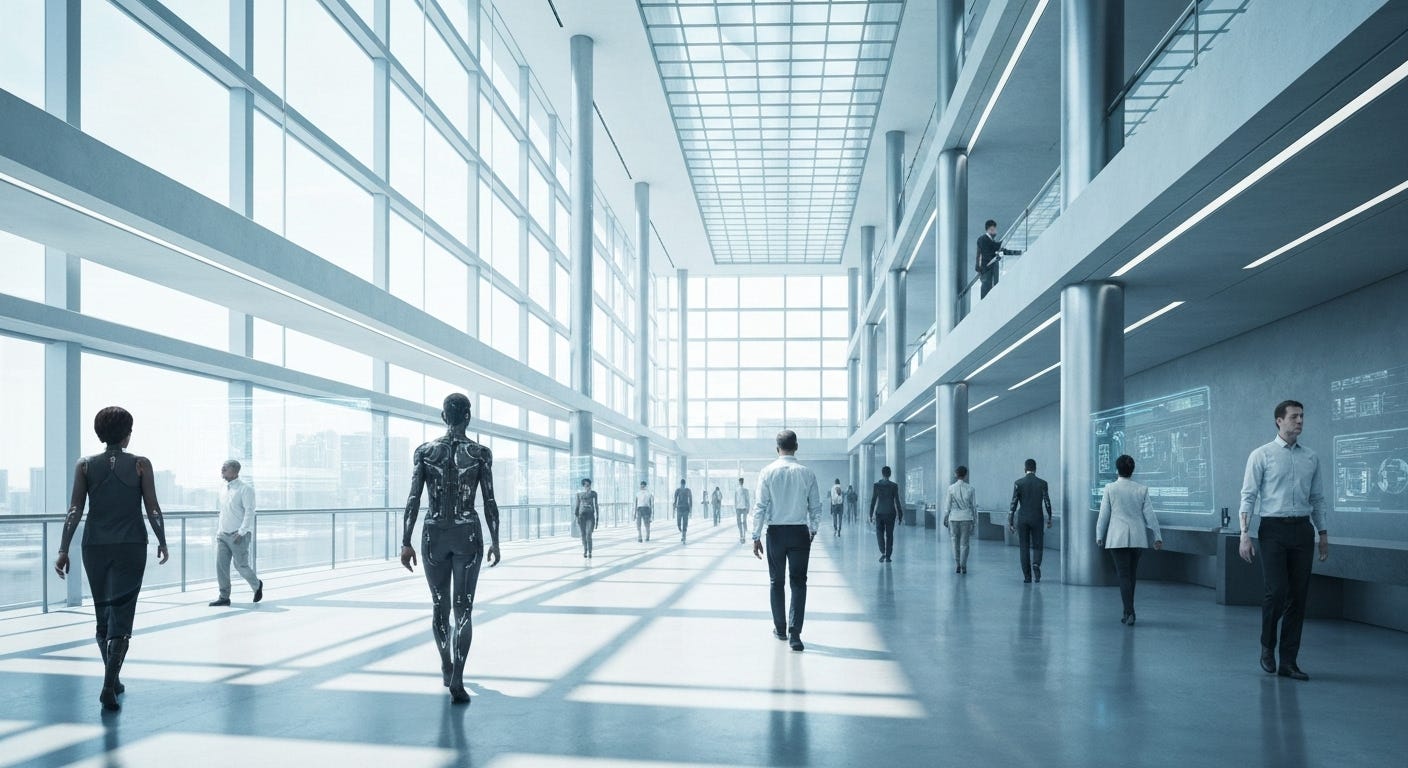
Genetic Design As Standard: CRISPR isn’t just for fixing diseases anymore. It’s for building the person you want to be. Want better muscle density? Longer life span? Resistance to depression? You can order it.
Direct Neural Interfaces (DNIs): Brain-computer interfaces that are integrated into your neurology. Not external devices. Part of you. They let you download skills. Share emotions. Connect to collective consciousness.
Probable Trajectory Algorithms: An AI that looks at your genetics, your neural patterns, your historical performance, and tells you: here’s what you’re optimized for. Here’s what you should become. Here’s your path.
Intentional Gestation Pods: Children aren’t born. They’re designed. Grown in artificial environments. Pre-entangled for quantum consciousness. Optimized before they even draw their first breath.
Bio-Aesthetic Status Markers: Your enhancements are visible. They’re not just upgrades, they’re symbols of status. Everyone can see what you’ve chosen to become. And everyone judges you for it.
The result? A world where you’re no longer born. You’re manufactured. Where your potential isn’t mysterious, it’s predetermined. Where your identity is something you design like you design a piece of software.
Elara wakes to her neural net. A soft prompt tells her: Resonance Drill. She connects her DNI. Her mind is immediately flooded with the collective’s “Emotional Coherence Wave”, a blend of feelings that have been pre-selected, optimized, designed to make her feel aligned with society.
Her sister has received her algorithm. “Probable Trajectory: Deep-Space Bio-Engineer.” Her path is laid out. Her neural integrations are recommended. Her genetic package for zero-g resilience is already in the system.
Elara’s algorithm says: “Cultural Data Harmonization.” A necessary role. Not ambitious. Not prestigious. Just... necessary.
And she wants to paint. She wants to do something her algorithm says is “suboptimal.” And she knows that choice will have consequences. Counseling. Resource reallocation. Social friction.
She’s free to choose. Just not free to choose wrong.
The Cruelty: Freedom as a Design Choice
Here’s what makes this scenario genuinely tragic: you’re free to become anything, as long as it’s optimized.
This is the paradox of designed evolution. You have unprecedented agency. You can reshape your body. You can augment your mind. You can become something your parents could never have been. You can transcend the limitations that plagued previous generations.
But the moment you use that agency to become something the algorithm didn’t predict, something that doesn’t optimize for collective harmony or competitive advantage or measurable success, you’re immediately met with friction. Counseling. Re-education. Social pressure.
You can choose to be anything. You just can’t choose to be suboptimal.
Which means you’re not actually free. You’re free within the parameters of optimization. Free to make choices that have already been vetted. Free to become better versions of the predetermined self.
But genuine freedom, the freedom to become something nobody predicted, something that doesn’t fit the algorithm, something that’s authentically you in a way that transcends design, that freedom is gone.
The Deepest Problem: The Loss of the Accidental Self
But here’s what keeps the jester awake at night: you’ve lost the possibility of becoming yourself by accident.
Think about how humans actually evolved into who they are. Not through conscious design. Through accident. Through the collision of circumstance and choice. Through surprise. Through making mistakes and having to live with them. Through discovering capacities you didn’t know you had. Through being pushed into situations where you had to grow.
The accidental self, the self that emerges through lived experience, through resistance, through struggle, that self is authentic in a way a designed self can never be.
But in a world where you can order yourself from a catalog, where your trajectory is laid out by an algorithm, where your enhancements are chosen by a committee of genetic designers, there’s no room for accident anymore. There’s no possibility of becoming something you didn’t plan to become.
Elara wants to paint. It’s not in her algorithm. It doesn’t optimize for anything. It’s not on her “Probable Trajectory.” But she wants to anyway. And when she acts on that impulse, when she chooses something not pre-designed for her, she encounters resistance.
Because the system can’t tolerate unauthorized becoming. Becoming that doesn’t serve the collective. Becoming that doesn’t optimize for anything. Becoming that just is, for its own sake.
And slowly, the possibility of that kind of becoming dies. People stop choosing things that aren’t pre-vetted. They stop following impulses that don’t align with their algorithm. They stop becoming themselves accidentally and start becoming the self they were designed to become.
They’re optimized. They’re augmented. They’re enhanced. But they’re not alive in the way humans were alive when they had to figure out who they were through living.
The Tragedy: The Unaugmented As Rebellion
In The Harmonized Ascent, there are people who opt out. Kael is one of them. An “unaugmented natural.” Someone who refused the enhancements. Someone who went to one of the “Unaugmented Zones” where DNI usage is restricted.
And what Kael has that nobody else has is: unmediated experience. An unfiltered sunset. Thoughts that are genuinely his, not pre-resonated or optimized by collective neural networks. The messy, unpredictable, utterly un-designed experience of being alive.
But Kael is increasingly rare. And increasingly marginalized. Because in a world of designed optimization, un-designed authenticity is seen as failure. As refusal to participate. As settling for less than you could be.
The system doesn’t forbid Kael’s choice. It just makes it impossible to value it.
The Undesigned Rebellion (How to Stay Accidentally Yourself)
So if the future is going to let you design yourself into perfection, what do you do now? How do you preserve the sacred capacity to become yourself by accident?
1. Refuse the Perfect Choice
The system will offer you the optimal path. The algorithm will tell you exactly what you should become. One of the most radical things you can do is: choose poorly.
What you can do:
Do something your skills don’t justify. Take a class in something you’re not good at. Pursue a hobby that doesn’t optimize for anything.
Make choices based on whim instead of optimization. Follow curiosity instead of career advancement. Choose the path that calls to you, not the path that calculates to success.
Say no to enhancements that would help you. Stay ordinary in ways that matter. Resist the temptation to upgrade yourself to match what the algorithm thinks you should be.
Develop talents that don’t scale. Learn something that can’t be monetized. Become skilled at something useless. The uselessness is the point.
You’re essentially preserving the possibility of becoming something you didn’t plan.
2. Protect Your Evolutionary Autonomy
Evolution is happening to you right now, whether you notice it or not. Your mind is being shaped by your choices, your environment, your relationships. But that evolution is yours. Organic. Unplanned. Genuinely emerging.
What you can do:
Be wary of life-optimization advice, even when it seems helpful. Every recommendation to “improve yourself” comes with an implicit design. Resist it. Let yourself evolve messily.
Spend time with people who know you before optimization. People who loved you for who you were, not who you could become. These relationships keep you tethered to your authentic, pre-designed self.
Make decisions without consulting algorithms. Not every choice needs to be optimized. Some choices should be made blindly, intuitively, dangerously.
Refuse to let your potential be measured. The moment someone says “You could be so much better if you just...”, resist. You’re not a project to be improved. You’re a person to be lived.
You’re essentially defending the right to evolve on your own terms, according to your own hidden logic.
3. Embrace Limitation As Identity
The system’s great seduction is the promise of limitlessness. You can be anything. You can enhance away your weaknesses. You can optimize your way to perfection. But limitation, real, honest, un-augmented limitation, is what makes you you.
What you can do:
Own your weaknesses. Don’t apologize for them. Don’t treat them as problems to be fixed. They’re part of who you are. They shape how you move through the world.
Say no to augmentations that would eliminate struggle. Yes, you could enhance your way to never being tired. But tiredness teaches you something. Struggle teaches you something. Limitation teaches you something no algorithm can predict.
Cultivate skills slowly, the hard way, without enhancement. Not because it’s efficient, but because the difficulty is where growth actually lives.
Teach others, especially young people, that you don’t have to be optimized to be worthy. That the unenhanced version of you has value. That your limits are part of your beauty, not obstacles to overcome.
You’re essentially insisting that your flaws are features, not bugs.
4. Question the Premise of Design
The whole system is built on an assumption: that you should know who you want to be before you’ve lived.
But that’s not how humans actually work. Humans discover who they are through living. Through making mistakes. Through being surprised by themselves. Through encountering situations they never predicted.
What you can do:
Study the difference between designed improvement and organic growth. Read about people who became themselves through accident, not plan. Artists who stumbled into their medium. Scientists who discovered by wandering. Humans who became great through being broken.
Question what “optimization” actually means. Optimized for what? According to whose values? Whose definition of success? Whose algorithm?
Advocate for narratives that celebrate unplanned becoming. Support art, literature, philosophy that values the messy, undesigned journey of self-discovery over the sleek optimization narrative.
Teach critical thinking about enhancement. Not “enhancement is bad.” But “enhancement according to whose design?”
You’re essentially refusing the premise that design is better than discovery.
5. Create Spaces for Un-Designed Becoming
The system will push you toward optimization at every turn. So you need to protect spaces where becoming is allowed to be messy, unpredictable, genuinely emergent.
What you can do:
Create or join communities that explicitly reject optimization hierarchies. Places where the unenhanced are valued. Where people choose limitation. Where being “suboptimal” is not just tolerated but celebrated.
Support and participate in “Unaugmented Zones” mentally, even if they don’t exist physically. Create mental spaces where you’re not connected to the network. Where you’re not optimized. Where you’re genuinely, defiantly un-enhanced.
Build mentorship relationships that aren’t about grooming you for optimization. Elders who teach you how to be authentically yourself, not how to become a better version of what the algorithm predicts.
Protect unconventional paths. Support people who choose careers that don’t optimize. Support people who opt out of enhancement. Support people who become themselves by accident instead of by design.
You’re essentially building infrastructure for the un-designed self to continue existing.
6. Think Systemically About Design Ethics
Individual choices matter, but they’re not sufficient. The entire system is incentivized toward optimization and enhancement. You need structures that protect the right to remain undesigned.
What you can do:
Advocate fiercely for “Augmentation Refusal Rights” legislation. The right to not be enhanced. The right to evolve at your own pace. The right to become yourself without algorithmic guidance.
Support international bio-ethics frameworks that center on human diversity, not human optimization. Frameworks that say “some people should remain unenhanced” not as a failure, but as a value.
Get involved in AI ethics governance. Push for algorithms that don’t assume optimization is always better. Push for design that values unpredictability as a feature, not a bug.
Fund and support research into the value of unenhanced consciousness. What does the unaugmented human mind offer that the enhanced one doesn’t?
The Sacred Accident
Here’s the final insight, and it’s crucial: the person you become by accident is more authentic than the person you design yourself to be.
Not because design is evil. Not because enhancement is wrong. But because you don’t know who you’re supposed to become until you’ve lived.
The moment you lock yourself into an algorithmic trajectory, the moment you say “this is what I will be optimized for,” you’ve foreclosed the possibility of becoming something you didn’t predict. Something better. Something more authentically you.
Elara wants to paint. The algorithm says it’s suboptimal. But the algorithm doesn’t know Elara. Not really. It knows her data. It knows her predicted trajectory. But it doesn’t know the part of her that wants to paint. The part that emerges not from calculation but from aliveness.
And if she suppresses that part to stay aligned with her algorithm, if she accepts the counseling and the resource reallocation and becomes the “Cultural Data Harmonizer” she was designed to be, she’ll be optimized. But she won’t be herself.
The jester’s final wisdom: the most important part of you is the part you didn’t design.
It’s the capacity to be surprised by yourself. It’s the ability to discover skills you didn’t know you had. It’s the possibility of becoming something nobody predicted. It’s the sacred accident of being alive and finding out who you are through living, not through downloading your predetermined trajectory.
So refuse the algorithm. Choose poorly. Become something nobody predicted. Make mistakes that don’t optimize for anything.
That’s where you are.
Not in the design.
In the deviation.
In the beautiful, unpredictable, accident of becoming yourself.