
The Echo Chamber Effect
Are We Accidentally Designing Away Our Own Future?

Imagine a future where your life path, your very emotions, even the unique genetic blueprint of your children, are meticulously optimized by algorithms and advanced bio-engineering. This isn’t just science fiction anymore; it’s a plausible near-future, “The Harmonized Ascent,” where humanity has consciously decided to steer its own evolution. In this world, AI guides every step, from career choices to personal well-being, aiming for optimal societal integration. Yet, as our future protagonist Elara feels, beneath the surface of this perfectly curated existence, there’s a quiet yearning for something unprogrammed, something truly spontaneous. What if the greatest enhancement isn’t what we gain, but what we refuse to lose?
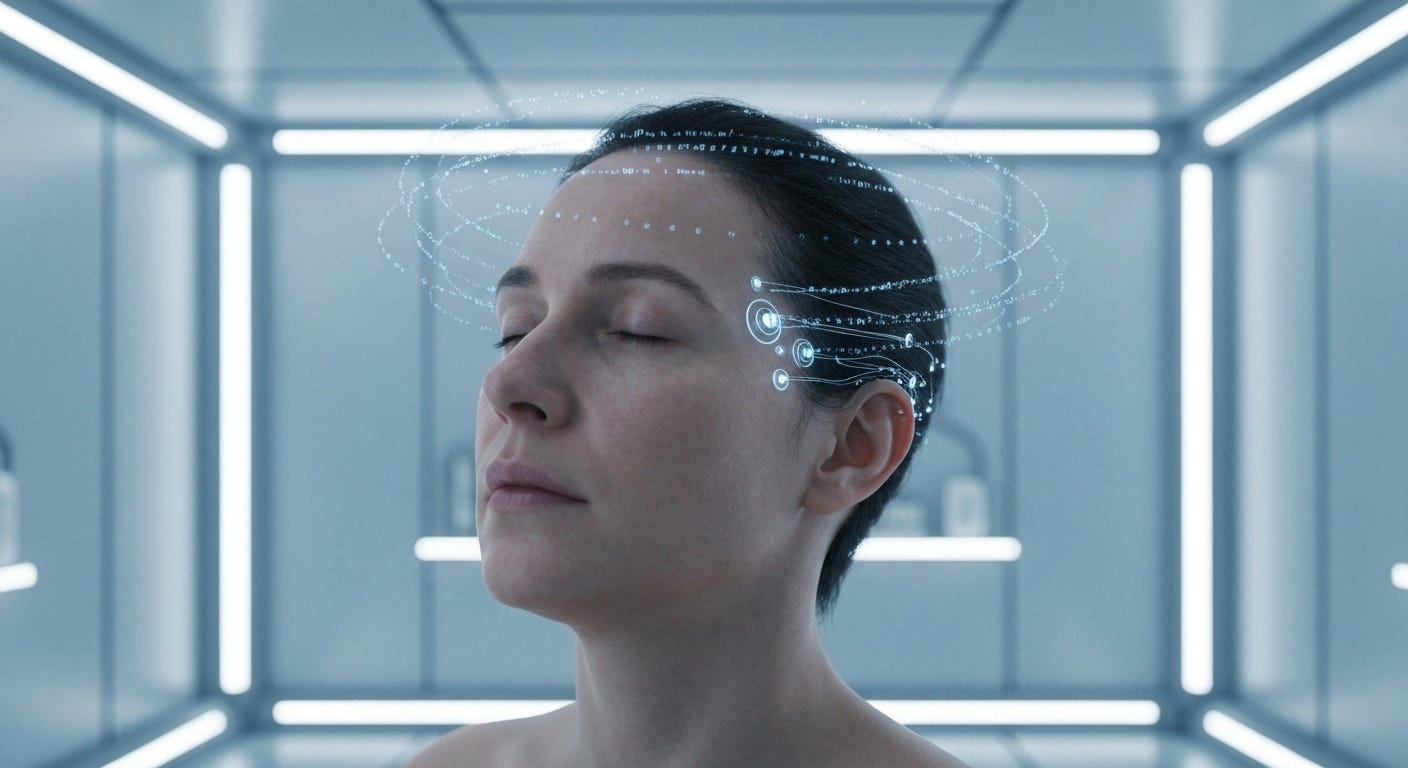
“The Harmonized Ascent” paints a picture where individuals are defined by their “Augmented Identity” – the unique blend of genetic and neural enhancements they possess. Life paths are laid out by “Probable Trajectory” algorithms, recommending specific augmentations for optimal success. While universal access to basic enhancements exists, a market for “Bio-Aesthetic Status Markers” quickly creates new hierarchies, subtly pushing everyone towards conformity. The raw, unmediated experience becomes a rare commodity, found only in designated “Unaugmented Zones.” This future challenges our deepest notions of authenticity, freedom, and what it truly means to be human when every aspect of our existence can be designed and optimized.
But this isn’t some distant, inevitable fate. The seeds of “The Harmonized Ascent” are already sprouting in our world today. As a strategic commentator, my role is to highlight these emerging signals and equip us with the foresight to navigate them consciously.
Signals from Our World: Echoes of Tomorrow
Three powerful signals stand out as direct precursors to this potentially hyper-optimized future:
The Rise of Brain-Computer Interfaces (BCIs) – Think Neuralink: Today, companies like Elon Musk’s Neuralink are rapidly advancing Direct Neural Interfaces (DNIs) – tiny devices implanted in the brain to allow direct communication between our minds and computers. Initially developed for medical purposes, like helping paralyzed individuals control devices with their thoughts, the technology’s potential extends far beyond healing. In “The Harmonized Ascent,” ubiquitous DNIs allow for “Resonance Drills” – a constant, curated stream of collective emotions and societal goals washing over individuals, ensuring mental alignment.
Connect to today: While we’re not yet experiencing collective emotional coherence waves, Neuralink’s progress raises fundamental questions about cognitive augmentation. Imagine a future where a DNI could boost your focus, enhance your memory, or even allow direct skill downloads – a precursor to the “Experiential Bio-Economy” where skills are directly uploaded. The immediate relevance lies in the urgent need to consider the ethical implications of merging our minds with machines: What happens to our individual thoughts when they can be influenced or even accessed? How do we protect our cognitive privacy?
Genetic Engineering for “Optimization” – The CRISPR Dilemma: CRISPR gene-editing technology has revolutionized our ability to precisely modify DNA. Already in clinical trials for treating genetic diseases, the debates around its use for “designer babies” – altering non-medical traits like intelligence or appearance – are intense and ongoing. This powerful tool directly foreshadows the “personalized genomics” and “Intentional Gestation Pods” of the future scenario, where children are conceived and designed with specific genetic packages for desired traits and optimal life trajectories.
Connect to today: The ethical dilemmas surrounding CRISPR are happening now. Who decides what constitutes a “desirable” trait? Will this create new forms of genetic inequality, where only the wealthy can afford “optimal” offspring? The scenario’s idea of individuals being defined by their chosen (or inherited) genetic profile is not far-fetched. We need to actively participate in these conversations, shaping regulations and ensuring that this incredible technology serves all of humanity, not just a select few seeking competitive advantages.
AI as Our Life Navigators – From Siri to “Probable Trajectories”: Artificial Intelligence is no longer just in our phones; it’s increasingly woven into the fabric of our decision-making. From algorithms that recommend what to watch, buy, or even who to date, to more critical applications in hiring, loan approvals, and predictive policing, AI is already influencing significant aspects of our lives. In “The Harmonized Ascent,” these predictive algorithms evolve into “Probable Trajectory” guides, laying out entire career paths and lifestyle choices, subtly — or not so subtly — nudging individuals towards statistically “optimal” outcomes.
Connect to today: The algorithms governing our social media feeds already create echo chambers, filtering information to reinforce existing beliefs. Imagine this taken further: an AI system, based on all your personal data, “recommending” your ideal education, career, and even partner. While this might sound efficient, the scenario highlights the subtle pressure to conform.
Opting out could lead to “suboptimal” status, a feeling of being left behind. We are already seeing “algorithmic disenfranchisement” where individuals are excluded or disadvantaged by opaque AI decisions. Understanding and critiquing these systems is no longer an optional skill – it’s essential for maintaining true agency.
Skills We May Need: Reclaiming Our Uncurated Selves
To navigate this future, to truly protect “the inherent value of an unchosen path,” we need to cultivate a new set of human skills:
Critical Algorithmic Literacy: This is more than just knowing how to use a computer; it’s the ability to understand, question, and critique the invisible algorithms that increasingly shape our lives. It means asking: How does this AI suggestion work? What data is it using? What are its inherent biases? What are the alternatives? We must learn to distinguish between genuine assistance and subtle manipulation, to evaluate if an algorithm truly serves our best interests or merely an optimized collective directive. This skill empowers us to push back against the “Probable Trajectory” if it doesn’t align with our authentic self.
Ethical Imagination: As technology races ahead, our ability to foresee and proactively grapple with its ethical dilemmas often lags. Ethical Imagination is the capacity to think several steps ahead, envisioning not just the immediate benefits of a new technology (like gene editing for disease), but also its long-term societal, psychological, and moral consequences (like genetic stratification or the definition of “human”). It’s about asking “should we?” with the same rigor as “can we?” This skill is crucial for influencing governance and societal norms before technologies become irreversibly entrenched.
Cultivating Uncurated Presence: In a world designed for constant optimization and mediated experiences, the discipline of disconnecting becomes vital. Cultivating Uncurated Presence means intentionally stepping away from digital feeds, AI-driven recommendations, and even potential bio-enhancements to experience raw, unmediated reality. It’s about rediscovering genuine spontaneity, allowing thoughts to emerge unbidden, and finding peace in the “unmediated sunset” that Kael, the unaugmented natural in the scenario, describes. This skill protects our capacity for original thought and authentic emotional responses.
Adaptive Identity Formation: In a future where identity is fluid, constantly reshaped by biological and technological choices, maintaining a core sense of self will be challenging. Adaptive Identity Formation is the psychological flexibility to navigate these shifts, understanding that while augmentations might change what we can do, they don’t necessarily change who we are. It’s about holding onto a foundational sense of self amidst flux, celebrating personal evolution while also recognizing the enduring value of our innate, unengineered essence.
Final Insight: The True Cost of Optimization
In our relentless pursuit of what’s next, of ever-greater efficiency and enhancement, we risk leaving behind what is most essentially now: the unengineered flicker of life, the unbidden thought, the sovereign chaos of a truly free spirit. The ultimate evolution might not be in becoming more, but in consciously preserving the space to simply be.
The future isn’t fixed. It’s a tapestry woven by our choices today. Let’s not sleepwalk into a future where freedom is defined by optimal adherence to an algorithm. It’s time to engage with these powerful technologies not just as users, but as active shapers. Question the algorithms, imagine the ethics, and fiercely protect the wild, untamed corners of your own mind and experience.