
The Future is Calling
Are We Ready to Anchor Ourselves?

Imagine a world where reality itself is a customizable canvas, where you can live out any fantasy, achieve any impossible feat, and build your perfect life with a thought. This isn’t just science fiction anymore; it’s a future scenario, “The Shard-Walker’s Anchor,” that suggests a world shaped by hyper-real simulations so vivid they become indistinguishable from physical reality. In this future, our identity might shift across countless digital realms, offering perfect belonging and purpose, but at what cost to our connection with the raw, unpredictable world we currently inhabit?
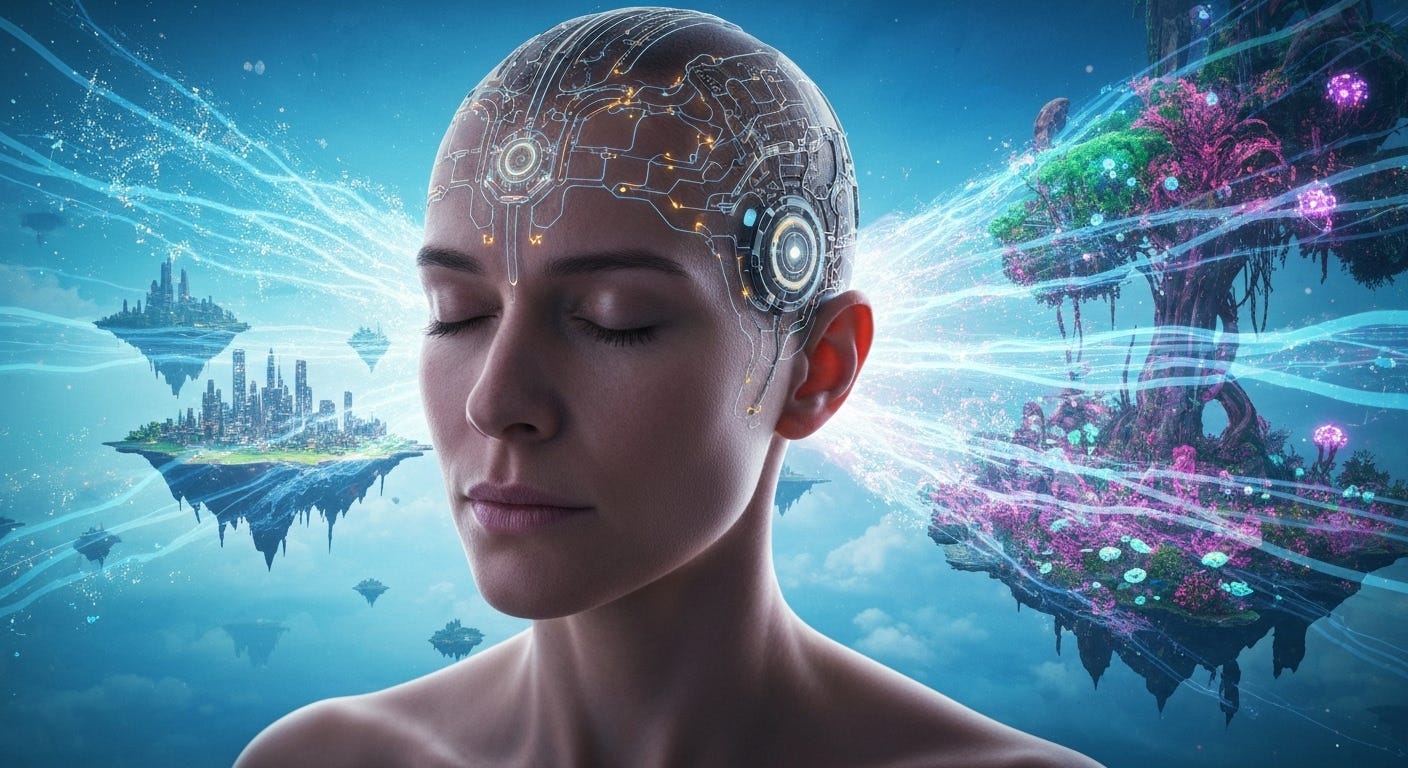
My role is to bridge this compelling future to our present moment. The seeds of this ‘shard-realm’ existence are not only planted but are already sprouting around us. By recognizing these crucial signals today and understanding the human skills they demand, we can prepare, influence, and perhaps even choose a better path forward.
Signals From Our World: The Precursors of Customizable Reality
The scenario paints a picture of ‘shard-realms’ powered by “Axiomatic Reality Engines” and accessed through “Ubiquitous Bio-Cognitive Interfaces.” While those terms sound futuristic, the building blocks are already here, shaping our daily lives and subtly nudging us towards a profoundly different future. Here are three crucial signals emerging from our current world that are direct precursors to the Shard-Walker’s journey:
The Rise of the Metaverse and Digital Economies:
What it is: Giants like Facebook (now Meta), Microsoft, and Epic Games are pouring billions into building interconnected virtual worlds – the “metaverse.” Think of platforms like Roblox or Decentraland, where people buy virtual land, attend concerts as digital avatars, and even hold jobs. This isn’t just about playing games; it’s about living parts of our lives online, fostering digital communities and generating real-world value from digital assets.
How it connects to the future: These metaverses are the nascent ‘shard-realms.’ They are already demonstrating a growing psychological pull towards virtual belonging and achievement. The “digital capital” we accumulate in these spaces – whether it’s rare in-game items or highly-valued virtual real estate – directly foreshadows the “sim-capital” and “Self-Assemblage Portfolios” that define status and identity in the future scenario. Our growing comfort and investment in these digital spaces indicate a powerful societal shift towards finding meaning and purpose in engineered realities.
AI’s Rapid Generative Capabilities:
What it is: In just a few short years, AI tools like ChatGPT, Midjourney, and Sora have become astonishingly good at generating realistic text, images, and videos. These AIs can create entire articles, lifelike portraits of people who don’t exist, or even short video clips that are almost indistinguishable from real footage. This isn’t just about automation; it’s about AI becoming a sophisticated creator of content, art, and even entire narratives.
How it connects to the future: These generative AIs are the early prototypes of the “Axiomatic Reality Engines (AREs)” that dynamically generate and modify the fundamental laws of simulated environments in the future scenario. They are already blurring the line between real and artificial, impacting our understanding of authenticity and altering our creative processes. As these AIs become more powerful, they will be capable of weaving the intricate, perfectly curated narratives and experiences that define the hyper-real simulations of the future, making every digital interaction feel utterly convincing and deeply personal.
Neural Interfaces and Seamless Immersion:
What it is: Companies like Neuralink and Synchron are actively developing “brain-computer interfaces” (BCIs) – devices that connect our brains directly to computers. While currently focused on medical applications (like helping paralyzed individuals control devices), non-invasive EEG headsets already allow rudimentary control of digital objects with thought. This technology aims to move us beyond clicking, typing, or swiping, towards a future of direct, thought-driven interaction with digital realms.
How it connects to the future: These BCIs are the direct precursors to the “Ubiquitous Bio-Cognitive Interface (BCI) Integration” of the future. The scenario describes these interfaces as blurring the lines between our biological selves and the simulated environment, facilitating seamless immersion. As these technologies mature, they will unlock the ability to experience virtual worlds with all the sensory richness and emotional depth of physical reality, making the ‘shard-realms’ not just look real, but feel real in a profound, integrated way.
Skills We May Need: Anchoring Ourselves in a Fluid Reality
As these signals grow stronger, they highlight a pressing need for new human abilities. In a world where reality itself is pliable, certain skills will become not just valuable, but essential for maintaining our well-being, agency, and connection to a shared truth.
Cognitive Anchoring:
What it is: This is the conscious ability to ground yourself in the physical, ‘baseline’ reality. It’s about discerning between engineered experiences (like a perfectly curated online game) and uncurated, unpredictable, physical ones (like a walk in the woods). It means knowing when you are in a simulation and when you are in the un-programmed world, and appreciating the unique qualities of each.
Why it’s crucial: The future scenario depicts a world where the lines between simulated and physical reality are nearly erased. Without Cognitive Anchoring, individuals risk severe disorientation, losing their grasp on collective physical responsibility and potentially neglecting the planet that sustains their biological selves. To cultivate this now, we can practice mindfulness, engage in sensory experiences of the natural world, and consciously limit our immersion in purely digital realms, valuing the imperfections and unpredictability of baseline reality.
Ontological Discernment:
What it is: Think of this as the critical capacity to understand and adapt to different sets of rules and ethical frameworks across various realities. Just as you behave differently at work than with family, in the future, you’ll need to understand that the “laws of physics,” social norms, and even moral codes might dramatically shift from one shard-realm to another. It’s about critically evaluating the ‘truth’ and consequences within each environment.
Why it’s crucial: In the future, “meta-nations” will have their own emergent ethical codes, challenging traditional legal accountability. Without Ontological Discernment, individuals could be psychologically adrift, struggling with conflicting allegiances and a fractured moral compass. Today, we can practice this by critically evaluating the information we consume online, understanding the implicit rules of different social media platforms, and recognizing how various communities define truth and consequence.
Meta-Creative Fluency:
What it is: This goes beyond simply creating within existing systems (like building a house in a game). Meta-Creative Fluency is the skill to understand, design, and even challenge the underlying principles and axioms of systems themselves. It’s about not just being a player, but understanding how the game itself is coded, and having the vision to propose new rules or entirely new games. It’s about fostering genuine novelty rather than just consuming engineered comfort.
Why it’s crucial: The scenario warns of “axiomatic saturation,” where true, unpredictable discovery is sacrificed for engineered comfort. Without Meta-Creative Fluency, humanity risks becoming passive consumers of perfectly gratifying but ultimately constrained realities. To nurture this now, we should encourage critical thinking about technology design, learn basic coding, engage in open-ended creative projects that push boundaries, and question the “default settings” of our digital lives.
The Anchor We Need: Rediscovering Our Unaltered Truth
The Shard-Walker’s journey offers a profound final insight: even as we master the creation of infinite realities, the most profound quest might be to rediscover the irreplaceable value of the singular, unaltered moment. This, paradoxically, could be the key to unlocking our deepest, most authentic creativity.
The future is not just something that happens to us; it’s something we build, signal by signal, skill by skill. The choice is ours: do we drift unmoored into a sea of infinite, engineered realities, or do we consciously cultivate the anchors that will keep us grounded in shared truth and genuine human potential?
It’s time to start practicing Cognitive Anchoring, Ontological Discernment, and Meta-Creative Fluency.
What’s one thing you’ll do today to connect with unaltered reality?