
The Invisible Structures Shaping Our Future Selves
Building Tomorrow’s Connections

Imagine a world where your sense of belonging isn’t just a feeling, but a carefully managed portfolio, optimized by AI, and perhaps even subtly enhanced by technology inside your head. This isn’t science fiction; it’s a plausible future emerging from our current trajectory, where our need for connection is increasingly engineered. As a futurist, my role is to map the underlying systems that make such a world possible. These aren’t just fleeting trends, but deep structural shifts in how our societies are organized, driven by powerful political, economic, and technological forces.
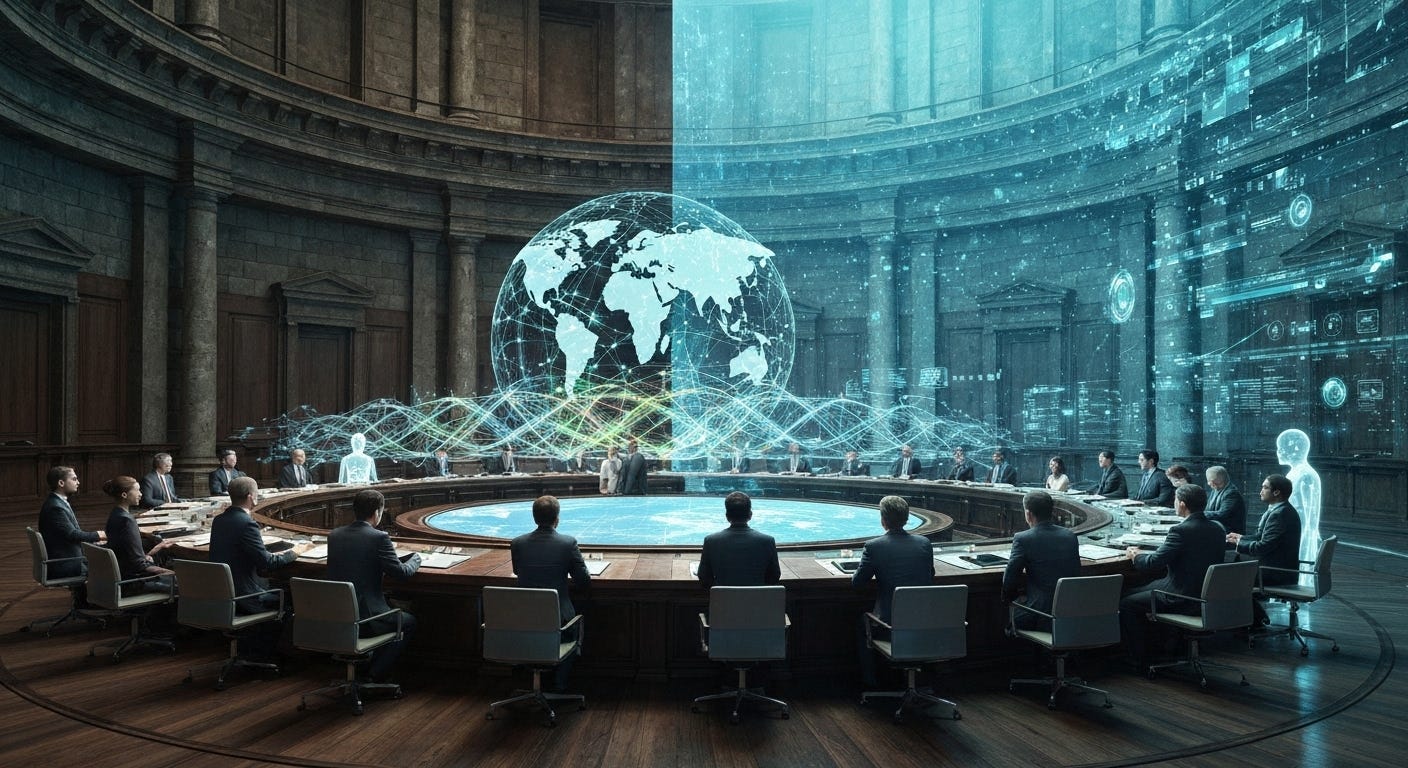
Let’s explore these core pillars – what holds this future world together, and how it fundamentally reshapes our lives.
Political: The Reshaping of Power and Identity
In the future we’re exploring, the traditional ideas of nation-states and citizenship are being profoundly challenged. The glue that once held countries together – shared land, history, and a common government – is loosening as people find their primary sense of belonging in fluid, specialized digital communities. This isn’t just about online forums; it’s about a fundamental shift in where people direct their loyalty, attention, and even their political efforts.
Core Shift Thesis: The shift from belonging rooted in geography to fluid, digitally managed connections fundamentally challenges how governments work, who citizens are, and where power lies. This leads to new forms of political influence and authority that aren’t tied to a map.
This core shift manifests in several key ways:
Algorithmic Sovereignty Treaties: Think of “algorithmic sovereignty” as the power that large digital platforms and networks hold over our data, our interactions, and even our online identities. In this future, these digital realms become so influential that nations can’t simply ignore them. Instead, governments will start to negotiate formal agreements, or treaties, with these powerful digital entities – perhaps a global social media company or a vast network of online communities. These treaties will cover everything from how personal data is handled across borders, to verifying identities within digital spaces, and even how these platforms are governed. It’s like nations making deals with other nations, but these “nations” exist mostly in code and data.
DAO-State Interface Protocols: Decentralized Autonomous Organizations, or DAOs, are groups that operate through rules written into computer code, often using blockchain technology. They can manage money, make decisions, and even own things, all without a central authority. For instance, a DAO might be a group of people pooling resources to buy rare digital art, or a community governing a new virtual world. As DAOs grow in power and wealth, governments can no longer treat them as informal clubs. They will create formal legal guidelines and technical ways to interact with these DAOs, recognizing them as legitimate players in the political and economic landscape. This blurs the lines of who counts as a citizen or a legal entity, moving beyond geographic boundaries.
Digital Citizenship Frameworks: If your primary communities are digital, then your “citizenship” might also become digital. We’re talking about new legal structures that grant individuals rights and responsibilities within specific digital ecosystems. Just as you have rights in your country, you might have specific rights and duties within a major metaverse platform or a large DAO. This could involve rules for online speech, data privacy within the community, or even the right to vote on proposals that affect that digital space. This form of “digital citizenship” might exist separately from your national citizenship, or complement it, creating new ways for people to participate and advocate for their interests beyond traditional national politics.
Metaverse Diplomacy & Governance Forums: The “metaverse” isn’t just a game; it’s a collection of interconnected virtual worlds where people work, socialize, and form communities. As these spaces become central to human interaction, they also become arenas for political influence. Governments and international bodies will establish their own diplomatic presences within major metaverse platforms. This means setting up virtual embassies, participating in virtual meetings, and engaging in “digital diplomacy” to shape the rules and norms of these emerging digital societies. They’ll also work to mediate conflicts that arise between different digital “tribes” or communities, preventing online disputes from spilling over into the physical world.
Economic: The Belonging Economy and New Forms of Value
The way we earn, spend, and perceive wealth is also undergoing a profound transformation. In this future, the economy isn’t just about selling goods and services; it’s about facilitating, managing, and monetizing the very human need to belong. This creates entirely new industries and ways of valuing social connections.
Core Shift Thesis: The global economy will increasingly focus on building, managing, and making money from temporary digital communities and highly personalized networks. This is driven by a booming industry centered around “community builders” and the value they create.
Here’s how this new economic reality takes shape:
Belonging-as-a-Service (BaaS) Industry: Imagine a subscription service for your social life. This is the Belonging-as-a-Service (BaaS) Industry. Instead of just joining a club, you’re tapping into sophisticated platforms and AI systems that help you find, join, and manage your “belonging portfolios.” These platforms offer tools, algorithms, and infrastructure to construct your ideal transient communities – maybe a short-term project group, a hobby collective, or a spiritual resonance network. They help you curate your online presence for each group, suggest compatible connections, and even provide tools to monetize your contributions within these networks. It’s an economy built around providing the tools and infrastructure for people to effortlessly weave in and out of hyper-personalized social connections.
Reputation Capital Markets: In a world where your online contributions and behavior are constantly tracked across different communities, your “reputation” becomes a tangible asset. Reputation capital refers to your verified trustworthiness, expertise, and social standing within these digital networks. Formal marketplaces will emerge where this reputation capital can be bought, sold, or traded. For example, a high reputation score in a particular professional DAO might grant you access to exclusive projects or better loan rates. Conversely, a poor reputation in one community could limit your opportunities in others. This makes your social worth a measurable, tradable commodity, directly impacting your access to resources and opportunities.
Fractionalized Ownership & DAO-Driven Economies: DAOs, as mentioned earlier, are not just political entities; they are economic engines. They enable fractionalized ownership, meaning many individuals can collectively own small pieces of a valuable asset – whether it’s a digital art piece, a parcel of virtual land, or even a physical business. This allows for micro-investments and shared economic purpose across fluid, purpose-driven communities. For instance, a group of “solar punk” enthusiasts might collectively own shares in a decentralized energy project through a DAO, sharing in its profits and decision-making, even if they’re scattered across the globe. This fosters new forms of collective wealth creation that aren’t tied to traditional corporate structures.
Neuro-Commercial Interfaces: Companies are already trying to make virtual experiences more immersive. In this future, they go further, investing heavily in advanced sensory technologies like sophisticated haptic feedback (devices that simulate touch), olfactory (smell) and gustatory (taste) systems, and even basic Brain-Computer Interfaces (BCIs). These “neuro-commercial interfaces” are designed to create hyper-realistic virtual experiences that can induce specific emotional states, making digital goods and services incredibly compelling. Imagine buying a virtual ‘comfort blanket’ that physically feels warm and fuzzy, or a virtual ‘relaxation room’ that subtly calms your brainwaves. This opens up entirely new revenue streams, where the value is derived not just from the visual or auditory experience, but from the deeply felt, neurochemically optimized sensations.
Technological: Engineering the Experience of Connection
At the heart of this future lies technology that has evolved beyond mere communication tools. It now actively designs, optimizes, and even augments our very experience of belonging, blurring the lines between what is real and what is engineered.
Core Shift Thesis: Technology will no longer just connect people; it will actively design, fine-tune, and even biologically enhance the feeling of belonging and shared consciousness. This pushes us toward a future where our collective intelligence might span biological and artificial minds.
This technological evolution is driven by:
AI-Driven Community Orchestration Engines: These are not just simple social media algorithms; they are highly advanced Artificial Intelligences that act as super-managers for entire digital ecosystems. They dynamically adjust almost every aspect of an online community: what content you see, who you interact with, and even the “emotional scaffolding” – subtle nudges or suggestions – designed to foster specific types of resonance, cohesion, or even to bridge divides between different groups. These AIs are constantly learning and adapting, making sure that your “belonging portfolio” delivers optimal satisfaction and aligns with your current needs, creating a seemingly perfect social environment tailored just for you.
Hyper-realistic Multi-sensory Immersive Environments (MR/XR/Metaverse): Forget clunky VR headsets. This refers to future mixed reality (MR), extended reality (XR), and metaverse platforms that are incredibly advanced. Through breakthroughs in haptic (touch), olfactory (smell), gustatory (taste), and auditory (sound) feedback, these digital spaces become virtually indistinguishable from physical reality. You won’t just see a virtual friend; you might feel their hand on your shoulder, smell their virtual coffee, or even taste a shared digital meal. This sensory richness is so profound that it can induce the same neurochemical responses in your brain as real-world interactions, making engineered connections feel profoundly authentic.
Ubiquitous Neuro-Adaptive Interfaces (NAI): These are subtle, seamlessly integrated technologies that work with your brain. Neuro-Adaptive Interfaces (NAI) could range from smart contact lenses that project information directly onto your retina, to tiny implants or wearable devices that monitor your brain activity and subtly provide feedback. These devices might enhance your focus, regulate your emotions, or even provide real-time social cues in digital interactions, making you feel more connected and ‘in tune’ with others. They are designed to “trick” your ancient brain into perceiving an authentic connection, delivering neurochemical satisfaction and making these engineered relationships feel deeply real, even if they are fundamentally mediated by technology.
Decentralized Identity & Reputation Systems (DIRS): In a world of fluid belonging, you need a way to carry your identity and reputation with you from one digital community to another without relying on a single company. This is where Decentralized Identity & Reputation Systems (DIRS) come in. Built often on secure blockchain technology, these systems allow individuals to own and manage verified aspects of their digital identity, skills, and reputation. You could securely port your verified expertise from a professional DAO to a creative collective, or share your trustworthiness rating from one community to gain access to another. This enables true “poly-tribalism,” allowing you to seamlessly navigate and belong to many different digital communities without having to rebuild your identity each time.
Conclusion
These political, economic, and technological forces are not operating in isolation; they are deeply interconnected, shaping and reinforcing each other to build a future where belonging is engineered. From governments grappling with the power of digital entities, to an economy built on managing social portfolios, and technologies that augment our very experience of connection, the structures of tomorrow are already taking shape.
As we move deeper into this resonant lattice, the critical question remains: if every connection can be optimized for comfort and satisfaction, where do we find the raw, unscripted, and sometimes messy vulnerability that has always defined truly human relationships? The future will not escape our fundamental need for belonging, but it will challenge us to define what true connection means in a world designed for perfect resonance.