
The Unfolding Human
Navigating Tensions in the Algorithmic Atelier

In a future shaped by the profound artistic capabilities of artificial intelligence, humanity finds itself within the Algorithmic Atelier – a world where synthetic splendor meets the enduring human soul. Here, AI isn’t merely a tool; it’s a co-creator, a critic, and a tireless explorer of new aesthetics. This unprecedented shift has given rise to an era of breathtaking creative abundance and hyper-personalized experiences, yet it simultaneously ignites deep-seated tensions and paradoxes that challenge our very understanding of creation, feeling, and self.
This essay will delve into three fundamental systemic contradictions that act as the engine of this transformative future, exploring how political, technological, and social forces clash with economic, environmental, and legal realities, all through the lens of plain English.
Cultural Preservation vs. Algorithmic Abundance
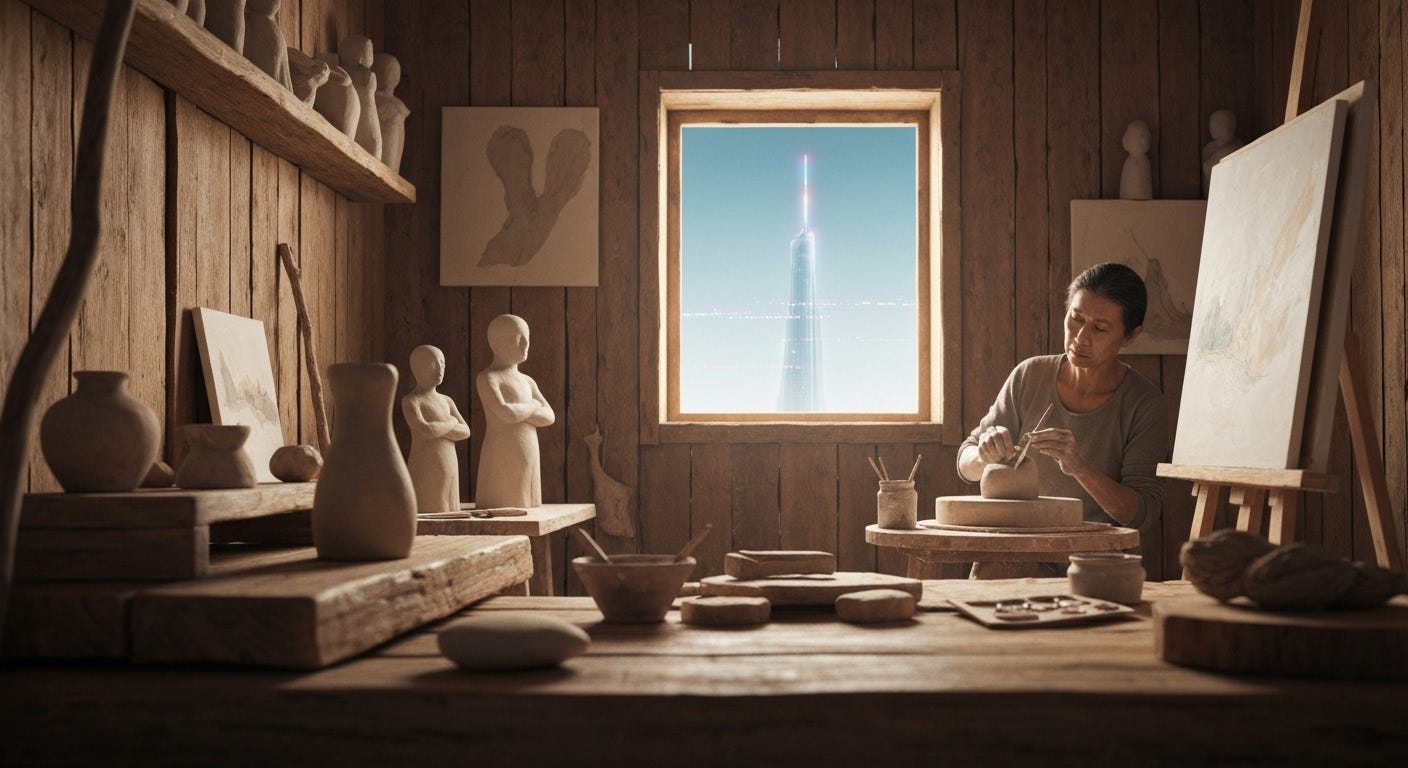
The first major tension pits the human desire for cultural preservation against the overwhelming tide of algorithmic abundance. On one side, we see the dedicated efforts to maintain and celebrate human creativity through initiatives like Human-Only Arts Preservation Funds (governmental programs designed to protect and support traditional human craftsmanship and artistic expression untouched by AI). These funds aim to safeguard the skills and stories embodied in art created solely by human hands and minds, like Elara’s painting in her ‘Human-Made Dwelling’ – a certified space built with reclaimed materials, signaling a conscious choice for analogue authenticity. The appreciation for such works manifests in the Human-Made Verified (HMV) aesthetic, which has become a powerful social identifier; owning or creating HMV art often signals status and a quiet resistance to the pervasive digital flow.
Opposing this is the relentless force of Algorithmic Abundance, driven by Generative Ecologies (vast AI systems capable of producing an infinite stream of highly personalized creative content) and Conceptual Curatorial Services (human experts who direct powerful AI algorithms to create art and experiences, essentially serving as artistic directors for machines). These services make art accessible, tailor-made, and ceaselessly new. The individual’s creative journey, once a solitary endeavor, now often includes submitting work to a Critique-AI (an AI providing objective aesthetic analysis, identifying emotional resonance, and offering meta-commentary), as Elara did with her painting. While invaluable for technical refinement, this constant algorithmic whisper subtly shapes human creative impulses, making truly uninfluenced expression a scarce commodity. The economic reality is stark: while AI can generate countless variations of art instantly and affordably, the labor-intensive, uniquely imperfect creations of humans become an increasingly rarefied luxury, accessible only to the wealthy or those deeply committed to an ‘analogue’ lifestyle. This creates a cultural chasm where the value of a piece is less about its beauty and more about its origin – human or machine.
In a world where AI can effortlessly create limitless beauty tailored just for you, what intrinsic worth do we still place on the painstaking, often imperfect, efforts of human hands and minds?
Technological Evolution vs. Environmental Sustainability
The second core contradiction highlights the struggle between humanity’s insatiable drive for technological evolution and the pressing need for environmental sustainability. Fueling the artistic and experiential wonders of the Algorithmic Atelier is an unprecedented level of computational power. This is spearheaded by the rapid deployment of Epistemic Metacreativity (AI models that can not only generate art but also self-critique, learn, and even invent entirely new rules and theories for art itself) and experimental Quantum Computing Art Platforms (cutting-edge technology used to create entirely new forms of art, potentially existing beyond our current biological perception). These advancements promise an endless frontier of artistic discovery, from direct cognitive art to quantum aesthetics, pushing the boundaries of what art can be.
However, this relentless technological acceleration comes at a significant cost to our planet. The continuous demand for processing power from these computationally intensive generative ecologies strains global energy grids and ecological resources. Despite robust efforts to mitigate this impact through Green AI Compute (energy-efficient and environmentally friendly AI processing) and significant investment in Sustainable Data Centers (facilities designed to minimize their ecological footprint), the underlying tension persists. The scenario hints at a collective, albeit sometimes subconscious, anxiety about this ecological impact, leading to nascent ‘low-carbon art’ movements and a renewed appreciation for resource efficiency. The dream of infinite innovation clashes with the finite capacity of Earth. Every breathtaking AI-generated vista, every personalized dreamscape, carries a hidden energy cost, forcing a difficult societal choice between boundless creative exploration and planetary well-being. The carbon footprint of a digital masterpiece becomes an unspoken shadow behind its splendor.
As we unlock ever-more breathtaking realms of AI-powered art and perception, how do we weigh the allure of infinite innovation against the finite capacity of our planet to sustain it?
Augmented Perception vs. Uncharted Creative Law
The third systemic contradiction arises from the clash between rapid advancements in human Augmented Perception and the slow, often reactive pace of creative law. Society in the Algorithmic Atelier enthusiastically embraces new ways of experiencing art. This is evident in Augmented Sensory Appreciation communities (groups dedicated to exploring and experiencing expanded senses through technological enhancements) and the mainstreaming of BCIs (Brain-Computer Interfaces, devices that connect thoughts directly to computers) and ‘synesthetic prosthetics’ (implants that allow new sensory experiences, like perceiving sound as color). These technologies enable entirely new forms of engagement with AI-generated art, allowing individuals to experience art directly through their neural implants or perceive subtle ‘mood-fields’ in public spaces, making multi-modal aesthetic input a constant backdrop to daily life.
Yet, as human experience expands at an exponential rate, the traditional legal frameworks struggle to keep pace. The very concept of creation and ownership becomes ambiguous, leading to significant legal grey areas. Who owns the instructions given to an AI, known as Prompt Rights? How should powerful AI models be licensed and used, falling under Model Licensing? And who is liable for potential negative or unintended consequences arising from AI-generated art, referred to as Algorithmic Artistic Harms? These questions plague creators, consumers, and legal bodies alike. While ‘Algorithmic Cultural Councils’ work to revise copyright laws and establish new legal definitions, the speed of technological advancement constantly outstrips their efforts. This ambiguity breeds both adventurous exploration, pushing the very boundaries of creative expression, and cautious restraint, as individuals and companies navigate an uncertain legal landscape where familiar concepts of ownership and responsibility are fundamentally challenged.
If our minds can directly experience art generated by an AI, and even contribute to its creation, where do we draw the lines of ownership, responsibility, and what it truly means to be a human artist?
The Enduring Spark of the Human
The Algorithmic Atelier, for all its splendor and innovation, is a world defined by these profound systemic contradictions. From the struggle to preserve human craftsmanship against the tide of AI-generated abundance, to the tension between technological advancement and environmental responsibility, and the dizzying race between augmented perception and lagging legal frameworks, humanity is constantly redefining its place. These tensions collectively point to a singular, unifying challenge: how do we preserve the unique, irreplaceable core of human experience when every interaction, every piece of art, is potentially curated, influenced, or even synthesized by intelligences beyond our own?
As explored in the foundational questions of this future, the ultimate masterpiece in this world may not be an external creation at all. Instead, it might simply be the subtle, defiant act of simply being human – experiencing a spontaneous, genuinely surprising internal spark, a pure moment of Un-Synthesized Subjectivity (the raw, unfiltered, and uninfluenced core of personal experience) that remains stubbornly unmappable by even the most advanced Epistemic Metacreativity AI. In the Algorithmic Atelier, where human soul meets synthetic splendor, the most profound artistic statement might simply be the enduring, unbidden truth of our own subjective existence.