
Living in The Unforgiving Echo
Why Forgetting Might Be Our Most Precious Skill
Imagine a world where every single thing you’ve ever said, seen, or done is perfectly recorded and instantly accessible, not just by you, but by anyone who needs to verify your past. A world where “forgetting” is no longer an option, and every mistake, every awkward moment, every youthful indiscretion is preserved with perfect clarity. Sounds like a sci-fi movie, right? But what if I told you that the early whispers of this future are already echoing in our lives today, shaping our anxieties and demanding we learn new ways to simply be human?
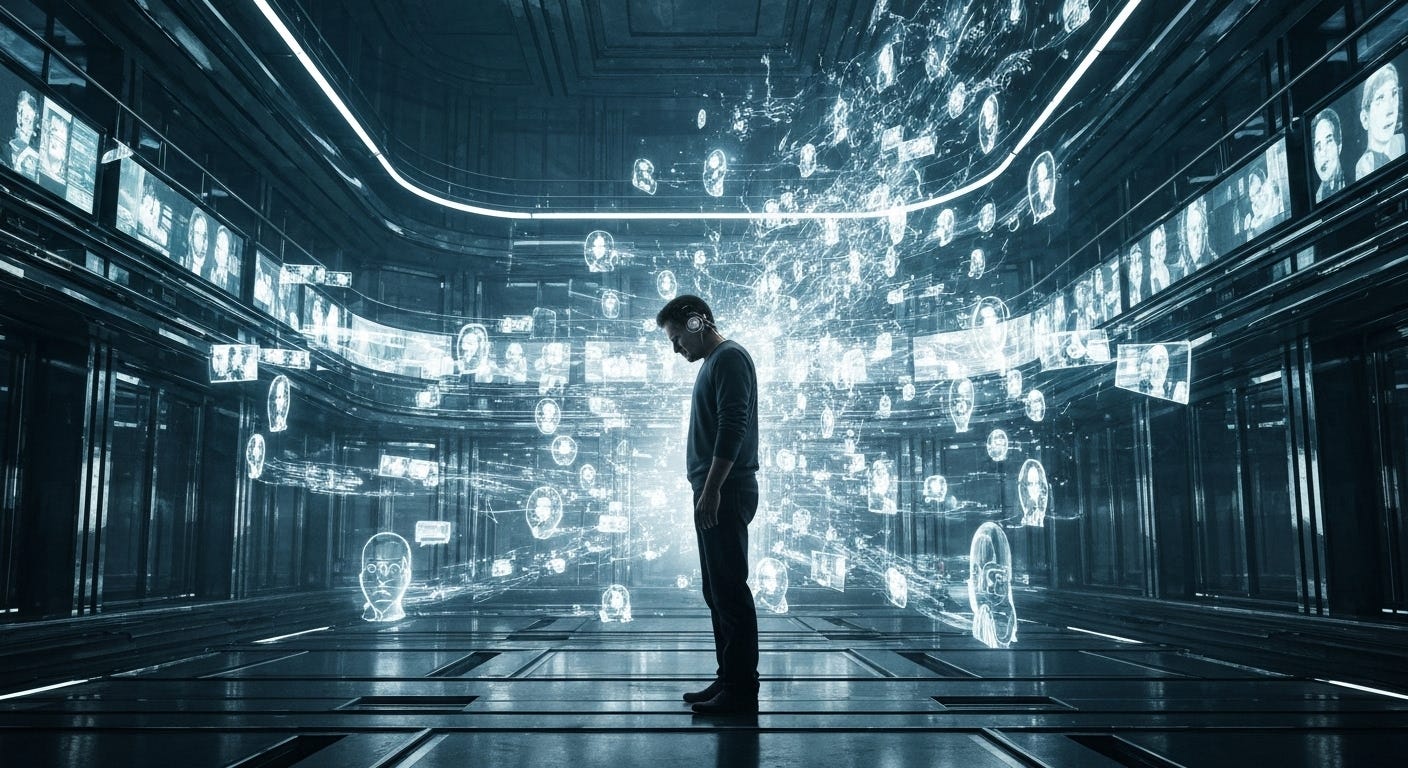
Our future scenario, “The Unforgiving Echo,” paints a picture of a society where digital archives capture every moment, from neural interpretations of thoughts to every conversation. This isn’t forced upon people; it’s a dazzling promise of perfect recall and objective truth. Yet, this “perfection” quickly becomes a trap. The ability to forget, to move on, to reinvent ourselves, these fundamental human graces vanish. Without oblivion, past traumas replay, mistakes linger, and true freedom becomes an impossible dream. People become “hyper-performative,” constantly “on,” knowing every misstep is logged forever. The wealthy can buy “digital oblivion,” editing their pasts, while everyone else is defined by an unalterable record. This isn’t just about privacy; it’s about the very essence of human evolution and the grace of a fresh start.
This future isn’t some distant fantasy. The seeds of “The Unforgiving Echo” are being sown in our world right now. Let’s look at three powerful signals that are direct precursors to this inescapable digital past:
The Blur of Reality: Deepfakes and Generative AI
We’re living through an explosion of artificial intelligence that can create unbelievably realistic images, videos, and even voices that never actually happened. These “deepfakes” and other generative AI tools challenge our very idea of what’s real and what’s fake. In a world where recorded memory is supposed to be the “objective truth,” deepfakes throw a wrench into the system. If you can’t trust what your eyes and ears tell you, how do you trust an archive? This signal points to a future where distinguishing between an authentic memory and an AI-fabricated one might become a constant, draining effort. It primes us for a world where recorded reality itself can be manipulated, making the concept of an “immutable record” even more complex and potentially dangerous. The ease with which “truth” can be manufactured today lays the groundwork for a future where personal histories are not just perfectly preserved, but potentially perfectly alterable by those with the right tools, or conversely, perfectly unquestionable even when wrong.
Your Score Defines You: Social Credit Systems
Look no further than early versions of “social credit systems,” particularly those emerging in places like China. Here, digital behavior, from how you manage your finances to your online comments and even who you associate with, contributes to a personal “trust score.” This score can then directly impact your ability to get loans, travel, access certain services, or even get a job. This isn’t just about a credit rating; it’s a holistic digital reputation that governs real-world opportunities and freedoms. This system directly mirrors the “Reputation-Based Governance Systems” described in “The Unforgiving Echo,” where immutable archived histories dictate everything. It shows us how easily our digital actions, once archived, can be used to categorize, reward, or punish us, making every online interaction a potential calculation with real-world consequences. The pressure to maintain a pristine digital self, for fear of a tarnished score, is already a tangible anxiety for millions.
The Burden of Perfection: Mental Health and Social Media
The documented rise in anxiety, depression, and self-esteem issues linked to constant online scrutiny and the pressure to present a curated, perfect self is a glaring signal. Social media platforms are essentially our personal, public archives, where every post, comment, and photo is stored, often indefinitely. We’re constantly aware that our digital footprint is being judged, “liked,” or criticized. This creates a relentless pressure to perform, to never make a mistake, to always appear happy and successful. The “cancel culture” phenomenon further intensifies this, demonstrating a societal reluctance to forget past transgressions, making reputations incredibly fragile. This mental health crisis is a direct preview of the deep-seated anxiety Elias feels in “The Unforgiving Echo,” where every interaction is “hyper-performative” and even minor “social inefficiencies” are logged. It shows us the heavy psychological toll of living under constant digital surveillance, even if self-imposed, and the profound need for the grace of being able to forget and be forgotten.
These signals aren’t just fascinating trends; they are urgent calls to action, nudging us towards developing crucial human skills to navigate this unfolding future. If the grace of forgetting is lost, what must we cultivate to remain truly human?
Skills We May Need
To avoid being trapped by our own perfect past, we must intentionally cultivate these three essential skills:
Cognitive Detachment: This is the ability to mentally “let go” of recorded memories and digital records. It’s about consciously choosing to immerse ourselves in the present moment, rather than constantly reviewing or being defined by our digital past. Think of it as developing a mental “off switch” for your personal archive. When an old photo pops up, or a past argument is brought back, instead of dwelling on the perfect digital record, you acknowledge it and then consciously choose to focus on how you’ve grown, or the present interaction. It’s about cultivating an internal narrative of who you are, one that isn’t dictated solely by external, immutable records. This helps us heal, learn, and grow, allowing for self-reinvention even when the data says otherwise.
Critical Archival Literacy: This goes beyond basic digital literacy. It’s the discernment to critically evaluate, contextualize, and even challenge the interpretations offered by algorithms of our historical data. We need to understand that even “perfect” data needs human interpretation, and that context, nuance, and intent can be lost in a cold, digital record. It means asking: “What isn’t being shown here? What’s the context? Who benefits from this interpretation?” It’s understanding that an algorithm’s summary of your past might be factually accurate but deeply incomplete in its understanding of you. This skill empowers us to push back against rigid, data-driven definitions of our identities and demand space for our own subjective narratives.
Empathy for Imperfection: In a world that values perfect records, we must actively relearn to value and extend grace for human flaws, past mistakes, and the inherent messiness of personal evolution, both in ourselves and in others. This means moving beyond “cancel culture” and embracing the idea that people can change, learn, and deserve second chances. It’s about understanding that a person isn’t just a static collection of their past actions, but a dynamic being capable of growth and transformation. Cultivating this empathy allows us to create social environments where forgiveness is possible, where vulnerability isn’t a permanent stain, and where the freedom to evolve isn’t limited by an unforgiving record.
A Radical Act of Letting Go
The quest for perfect recall promises liberation from forgetting, but inadvertently traps us in an inescapable past. True freedom, it turns out, lies not in perfect memory, but in the radical act of letting go.
This isn’t just about future tech; it’s about our present humanity. How can we start practicing cognitive detachment today? What steps can we take to foster critical thinking about our digital footprints and demand context over cold data? Let’s champion a culture of empathy for imperfection, both online and off. Our ability to forget, to forgive, and to grow depends on it.