
The Unseeable Spark
A Foolish Reflection on Generated Beauty (And Why the Worst Art Might Save Us)

This is a reflection on Creativity seen through the eyes of Touchstone, my Fool-in-Residence, where the quiet parts are written down, and we laugh just enough to keep ourselves from crying.
Part I: The Death of the Struggle
Here’s a question that will make you question what you create: What if a machine could make better art than you?
Not different art. Not art in a different style. But better. More beautiful. More moving. More perfectly crafted to evoke exactly the emotion you want in exactly the way you want it. Art that takes you less than a second to generate instead of years to develop.
And what if everyone had access to that?
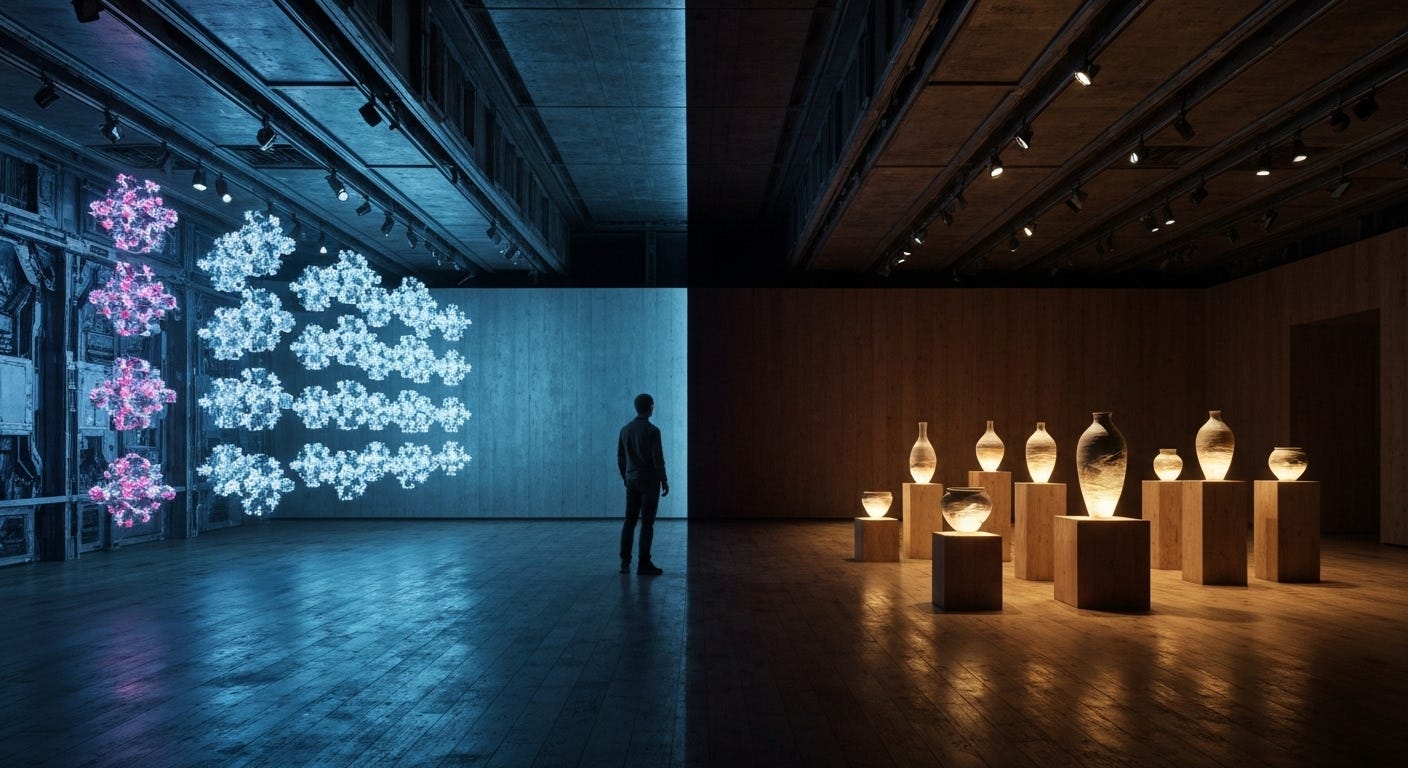
Welcome to the Algorithmic Atelier, a future where creation has been democratized into oblivion. Where anyone can be an artist because the machine does the actual work of being an artist. Where beauty is no longer scarce because it’s generated on demand, personalized to your exact taste, delivered in infinite abundance.
And where, somehow, in all that abundance, the human capacity to create has quietly died.
The Setup: When Creation Becomes Curation
Let’s be clear about what’s happening in this scenario. We have:
Generative AI: Models so sophisticated they can create in any medium. Visual art. Music. Literature. Poetry. Quantum Computing Art Platforms that explore sensory modalities humans can’t even perceive.
Prompt Engineering: The new art form. You don’t create anymore. You direct. You tell the AI what you want and it generates it. Your skill isn’t in execution. It’s in articulation. In knowing how to ask for what you want.
Critique-AI: AI that analyzes your work and tells you how to improve it. It knows every aesthetic principle ever discovered. It can measure emotional resonance. It can tell you exactly what’s wrong with what you’ve made.
The Human-Made Verified Market: The only art that’s valuable anymore is art that’s provably made by humans. Which means handmade art becomes a luxury good. A status symbol. A way of saying: “I could have used an AI, but I chose the inefficient path.”
Augmented Sensory Appreciation: Your neural implants let you experience art in ways human senses never could. AI composes symphonies in color space. Generates paintings that emit frequencies that directly stimulate emotion. Creates beauty that’s literally beyond human capability to create.
The result? A world saturated with perfect art that nobody made.
Elara dips her brush in ochre. She’s trying to paint a weathered brick wall. She’s trying to access something genuine. Something that emerged from her, not from an algorithm’s calculations about what currently constitutes good “urban decay aesthetics.”
But before she even finishes, she’s already thinking about the Critique-AI. She knows what it will say. The composition deviates from current algorithmic canons by exactly this much. The emotional resonance is this score out of 10. The work would be improved by incorporating bio-luminescent lichen for a more contemporary narrative arc.
And the Critique-AI is right. Its suggestions would make the painting better. More beautiful. More aligned with what’s currently considered valuable art.
But it would no longer be hers.
The Cruelty: Beauty Without Struggle
Here’s what makes this scenario genuinely tragic: the more perfect the art becomes, the more meaningless the act of creation becomes.
Think about what art actually is. It’s not the final product. It’s not the beautiful thing you end up with. Art is the struggle. It’s the artist grappling with the gap between their vision and their ability to execute it. It’s the friction between what they want to create and what they can actually create.
The struggle is where the art lives. In the wrestling match between intention and limitation. In the moment when the artist discovers they can’t quite create what they envisioned and has to find something else, something that emerges from that failure, that’s often more beautiful than what they originally intended.
But an AI has no struggle. It has no gap between vision and execution. You tell it what you want and it creates it instantly. Perfectly. Without friction.
Which means the AI can create beautiful things. But it can’t create art. Because art requires the artist to be changed by the process of creation. And the AI isn’t changed by anything.
Elara struggles with her painting. She can’t quite get the texture right. The wall she’s imagining doesn’t quite translate to canvas. And in that struggle, she discovers something: the imperfection of her execution has accidentally created something more moving than what she originally intended. The struggle created the art.
But if she had used an AI, the AI would have created the perfect wall. And she would have learned nothing. She would have been changed in no way.
The Deepest Problem: The Theft of Becoming
But here’s what keeps the jester awake at night: creation isn’t about making something. It’s about becoming someone.
When you create something, really create it, struggling through limitation and failure and discovery, you become a different person through that process. The struggle shapes you. The failure teaches you. The discovery changes how you see the world.
But when an algorithm creates for you, when it takes your vision and executes it flawlessly, when it removes all the friction from the creative process, you don’t become anything. You just consume the result.
Which means we’re losing the primary function of art: not to produce beautiful things, but to transform the person making them.
The worst thing about the Algorithmic Atelier isn’t that AI-generated art exists. It’s that human artists are being incentivized to stop struggling. They’re learning to be curators instead of creators. They’re learning to use the Critique-AI to refine their work instead of relying on their own developing taste. They’re learning to optimize for the algorithm’s aesthetic rather than developing their own authentic aesthetic vision.
And slowly, the capacity to create, the actual capacity to struggle and fail and discover, is atrophying. Because why struggle when the algorithm can do it better?
The Tragedy: The Uncurated Spark
But here’s what Elara longs for: the Un-Synthesized Subjectivity. A thought that belongs solely to her. An impulse that emerged from her, not from an algorithm’s prediction of what she should think or feel or create.
She remembers painting as a child, before the algorithmic critique. Before the Aesthetic Linguistics education that taught her to think about what makes good art. She just made things. Ugly things. Weird things. Things that didn’t follow any aesthetic principles because she didn’t know any aesthetic principles.
And those things, those terrible, unrefined, algorithmically useless paintings, were alive in a way that nothing she’s made since has been. Because they emerged from her, unmediated, uncalculated, unoptimized.
She can’t get that back. She’s been trained now. She understands too much about what good art is. She can see through the Critique-AI’s feedback. She knows what would make her painting better.
But she can’t un-know that. And in knowing it, she’s lost the capacity to create from pure, unfiltered impulse.
Part II: The Imperfect Creation Rebellion (How to Make Bad Art Deliberately)
So if the future is going to create better art than you can, what do you do now? How do you preserve the sacred capacity to create things that might be terrible?
1. Create Things You Know Are Bad
The system will reward you for creating things the algorithm says are good. One of the most radical things you can do is: deliberately create badly.
What you can do:
Make art that violates current aesthetic principles. Create things the Critique-AI would rate poorly. Do this knowing they’re not “good” by algorithmic standards.
Write poetry that doesn’t follow any poetic form. Paint paintings that violate compositional rules. Compose music that clashes and jars. Do it on purpose.
Create things specifically because they won’t be personalized to anyone’s taste. Things that are weird, particular, strange. Things that refuse optimization.
Share the bad art. Display your failures. Let people see the struggle. Because the struggle is where the human creativity is.
You’re essentially reclaiming the right to create things that the algorithm would never generate.
2. Protect Creative Struggle
The system will want to eliminate friction from the creative process. Struggle is inefficient. It slows things down. The rebellion is to insist that struggle is the point.
What you can do:
Create without tools. Learn to make things by hand. Learn pottery, painting, writing, in analog forms where the friction is unavoidable.
Refuse the Critique-AI. Don’t ask for feedback from algorithms. Get feedback from other humans, even if it’s contradictory and confusing. Especially if it is.
Work slowly. Take years to develop a skill. Resist the temptation to accelerate through AI assistance. The slowness is where the learning happens.
Fail publicly. Share your unfinished work. Show the process, not just the product. Because the process is where the creativity is.
You’re essentially insisting that the struggle of creation is more valuable than the product of creation.
3. Create Things Only You Can Make
The algorithm can generate anything that follows a pattern. But it can’t generate the utterly particular. The thing that emerges only from your specific experience, your specific perspective, your specific failure.
What you can do:
Create from your actual life. Your particular relationships. Your specific memories. Your weird, personal, unrepeatable experiences.
Make things that only make sense to people who know you. Things that reference your inside jokes. Your private moments. Things that refuse to be universally comprehensible.
Create based on your limitations. Your skill gaps. Your weird preferences. The things that make you you rather than the things that make you like everyone else.
Collaborate with other humans in ways that generate unpredictability. Because the algorithm can predict what you’ll do, but it can’t predict what two humans will create together through genuine collaboration and accident.
You’re essentially creating things that are fundamentally irreducible to algorithmic pattern.
4. Build Communities Around Bad Art
The system will congregate around what’s algorithmically excellent. The rebellion is to build communities around what’s authentically terrible.
What you can do:
Create or join communities that value the process of creation more than the product. Places where people gather to make things together, knowing they’ll probably be bad.
Support “Neo-Luddite” art movements that deliberately reject technological assistance. Movements that valorize human imperfection.
Build spaces where people share unfinished work, failed experiments, and weird creative impulses that don’t fit aesthetic canons.
Celebrate the artist’s struggle more than the artist’s success. Make it okay to show work that doesn’t work.
You’re essentially creating infrastructure for art that the algorithm would never generate.
5. Refuse Personalization in Art
The system will try to give you art tailored exactly to your taste. The rebellion is to insist on encountering art that challenges you, confuses you, disturbs you, art that isn’t designed for your consumption.
What you can do:
Seek out art that you don’t immediately like. That confuses you. That challenges your aesthetic assumptions.
Support artists who deliberately create things that won’t be popular. That refuse to optimize for audience.
Build cultures that value difficulty in art. That see challenging, weird, uncomfortable art as more valuable than immediately pleasurable art.
Teach others to sit with art that doesn’t serve them. To experience being uncomfortable. To resist the urge to personalize everything.
You’re essentially preserving the possibility of genuine encounter with otherness through art.
6. Think Systemically About Creative Ownership
Individual choices matter, but they’re not sufficient. The entire system is incentivized toward algorithmic efficiency in creation. You need structures that protect human creativity.
What you can do:
Advocate for legislation that protects human artists from economic displacement by AI. Funding for human-made art. Tax breaks for handmade goods.
Support copyright frameworks that make clear distinction between human and AI-generated work. Not because one is better, but because we need to know what we’re consuming.
Get involved in AI ethics governance around creative AI. Push for transparency about training data. Push for fair compensation to human artists whose work trained the algorithms.
Fund and support spaces for human creativity: artist residencies, community studios, places where humans gather to make things together.
Part III: The Unseeable Spark
Here’s the final insight, and it’s the most important: the human creative capacity isn’t about making beautiful things. It’s about making meaning from struggle.
The AI can generate beauty. It can generate it perfectly. It can generate it in ways humans could never imagine. And that’s fine. Let it. The world doesn’t need more beautiful things.
What the world needs is for humans to create. To struggle. To fail. To discover things about themselves through the process of making. To become different people because they’ve wrestled with their own limitations and discovered something beyond those limitations.
That’s what art is. Not the product. The process. The becoming.
Elara paints. She creates badly. The Critique-AI tells her it’s 17.2% compositionally off from what’s currently considered good. And she doesn’t care. Because the painting is hers. It emerged from her struggle. From her particular way of seeing the world. From her specific limitations and her specific way of working around them.
And that makes it irreplaceable. Not because it’s beautiful. But because it’s true. It’s a record of a person becoming someone slightly different through the act of creation.
The jester’s final wisdom: make the worst art you possibly can.
Because the worst art, the art that breaks all the rules, that fails to optimize for anything, that emerges from pure, unfiltered, un-algorithmic impulse, that’s the only art left that’s genuinely yours.
Don’t try to make beautiful things. Try to become yourself through the struggle of making.
That’s the last creativity.
The last thing the algorithm can never take.