
The Unseen Architects
How Political, Economic, and Technological Forces Build Our Designed Future

Imagine a future where humanity no longer simply adapts to its environment, but actively designs itself – from our genetics to our very thoughts. This isn’t a distant dream, but a near-future reality taking shape, one molded by powerful, interconnected forces that operate beneath the surface of everyday life. To truly understand this world, where the pursuit of optimization reshapes what it means to be human, we must look to the structural pillars of Political, Economic, and Technological systems. These aren’t just background elements; they are the unseen architects, constantly designing the very framework of our existence.
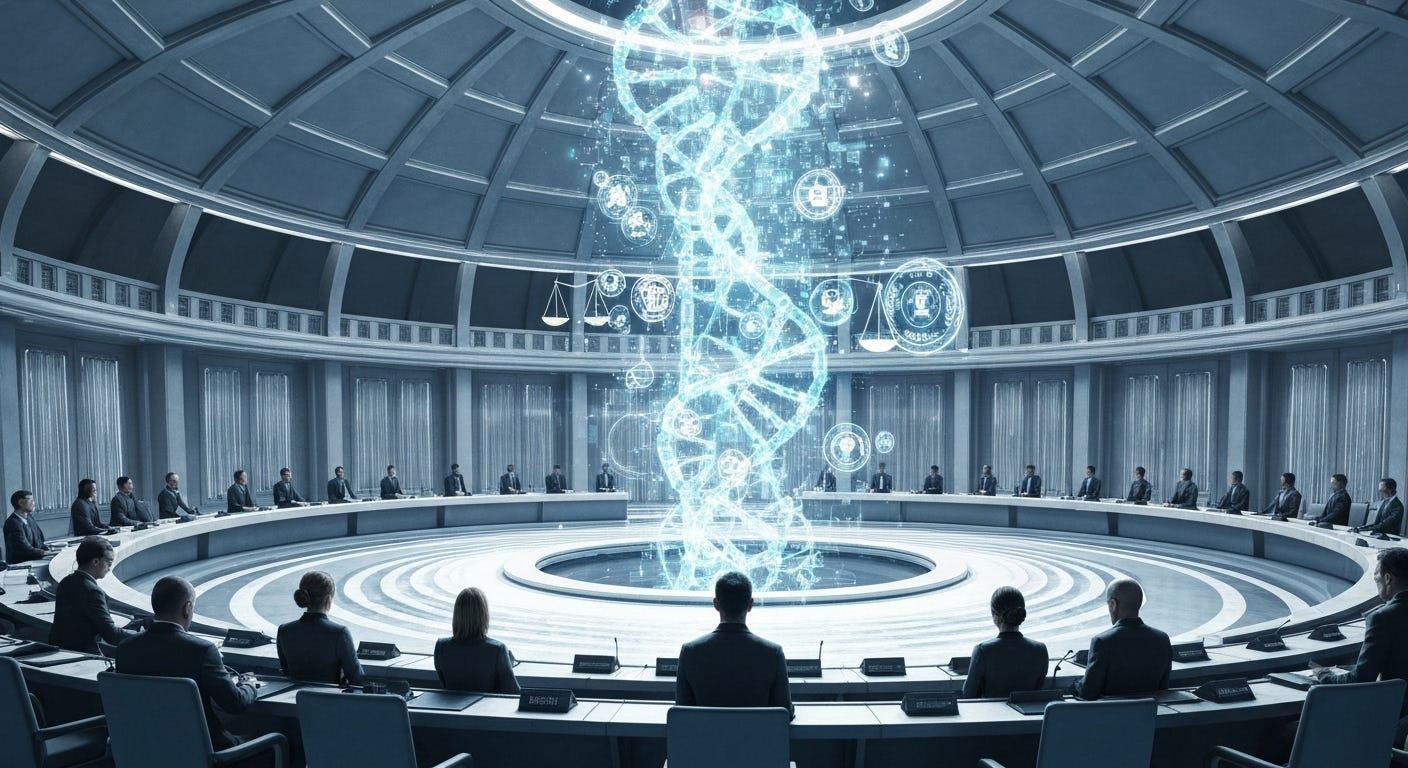
Think of it like building a complex house. The political system lays down the zoning laws and building codes; the economic system provides the resources and determines who gets what; and the technological system offers the tools and materials. In the scenario of “The Harmonized Ascent,” these three pillars aren’t just supporting structures; they are actively driving humanity towards a future of self-design, often without us fully grasping their profound influence. Let’s delve into how these core forces are shaping our destiny.
Political Forces: Governing the Human Blueprint
Core Shift Thesis: In “The Harmonized Ascent,” the role of governments expands dramatically. No longer solely focused on managing territories and traditional human populations, nation-states and international bodies now wield crucial regulatory power over biology itself. They are tasked with defining what “human” means in an age of enhancement, shaping everything from individual rights to global relations around the principles of bio-governance.
This shift creates a complex landscape of new laws and agreements designed to manage our rapidly evolving capabilities:
International Bio-Ethics Treaties: Just as nations agree on rules for nuclear weapons or climate change, global agreements are now being forged to regulate powerful biological and cognitive technologies. These treaties, often brokered by organizations like the United Nations or influential groups like the G7, aim to establish universal ethical standards and “red lines.” Their purpose is to prevent a dangerous biological arms race – where countries might compete to create superior augmented citizens or develop bio-weapons – by setting rules for things like germline editing (changing genes that are passed down to future generations), human augmentation (enhancing physical or mental abilities), and the use of advanced Artificial Intelligence (AI) in designing human biology.
“Augmented Citizen” Identity Legislation: As people gain significant biological or cognitive enhancements, national laws are emerging to define their legal status, rights, and responsibilities. What does it mean to be a citizen if you have a vastly superior memory or an enhanced immune system? This legislation addresses fundamental questions: Do augmented citizens have different voting rights? How do they access public services? Are there limits to what enhancements are permissible within society? These laws are a society’s attempt to grapple with a new class of beings, ensuring that fundamental principles of justice and equality, however challenged, are maintained.
National Augmentation Baseline Programs: To prevent extreme disparities and ensure everyone can participate in society, governments are launching programs that provide or subsidize specific, universally beneficial enhancements. Think of it like universal healthcare, but for biological upgrades. These “National Augmentation Baseline Programs” might offer advanced cognitive aids to boost learning, disease immunity packages, or sensory enhancements to improve vision or hearing. The goal is to provide a functional floor of enhancements, ensuring broad societal participation and preventing a stark divide where some people are fundamentally more capable than others due to wealth alone.
Algorithmic Governance & Transparency Directives: In a world heavily reliant on AI, algorithms aren’t just recommending movies; they’re making critical decisions about our lives, from career paths to resource allocation. Algorithmic governance refers to the use of AI systems to manage public services and societal functions. To counter potential issues like “algorithmic disenfranchisement” – where people are unfairly excluded or disadvantaged by automated decisions – governments are mandating transparency. These directives require that the AI’s decision-making processes be auditable, understandable, and ethically reviewed, ensuring human oversight and accountability where these complex systems influence our lives.
Economic Forces: The Price of Self-Design
Core Shift Thesis: The economy of “The Harmonized Ascent” moves beyond traditional manufacturing and consumption. Instead, its core value lies in the creation, access, and optimized integration of bio-cognitive enhancements and tailored subjective experiences. This new paradigm creates vast, lucrative markets, but it also intensifies debates about who gets access to these transformative technologies and how we ensure a fair distribution in a world where basic scarcity is less of a concern.
This economic shift defines new forms of wealth and new avenues for inequality:
Personalized Genomics & Augmentation Market: This is a booming industry where you can literally custom-order your own biology or cognitive functions. It offers bespoke genetic edits (precise changes to your DNA), advanced neural implants (devices connected to your brain), and sophisticated bio-mechanical enhancements (upgraded body parts). While the wealthy can afford cutting-edge, tailor-made solutions, standardized, mass-produced options are emerging for broader markets. This creates a two-tiered system where access to the most advanced enhancements remains a luxury, while more basic versions become increasingly commonplace.
“Experiential Economy” Expansion: Forget buying physical goods; in this future, you can buy experiences directly. The “Experiential Economy” is about purchasing direct neural downloads of skills (like learning a language instantly), curated emotional states (to manage stress or boost creativity), and high-fidelity simulated realities. This goes far beyond entertainment, extending into education, professional training, and even psychological well-being. Imagine downloading a complete understanding of astrophysics, or experiencing the profound joy of a simulated perfect day, all directly into your mind.
Universal Basic Augmentation (UBA) Initiatives: Mirroring the debates around Universal Basic Income (UBI), societies are now grappling with Universal Basic Augmentation (UBA). These are pilot programs or widespread policy discussions focused on providing essential biological or cognitive enhancements as a social safety net. The idea is to ensure that everyone has access to foundational enhancements necessary for participation in the increasingly augmented world, guaranteeing a baseline of capability and equity, much like how basic education or healthcare is considered a right today.
Bio-Capital Investment & Intellectual Property Wars: The potential for profit in the realm of human enhancement is staggering, leading to intense competition and massive financial investments in biotech firms. These companies fiercely guard their intellectual property – the patents and designs for advanced genetic engineering techniques, Direct Neural Interface (DNI) technologies, and new neuro-pharmacology (drugs for the brain). This creates “IP Wars” where legal battles and market monopolies determine who controls the future of human evolution and who profits from the very blueprints of our being.
Technological Forces: Tools for Self-Creation
Core Shift Thesis: In “The Harmonized Ascent,” technology is no longer just an external tool we use; it becomes an intrinsic part of our biology and consciousness. This profound integration enables unprecedented self-modification, allowing humanity to fundamentally alter its own nature and even begin to explore how quantum-level interactions might influence subjective reality.
These core technologies are the engines driving our self-designed future:
CRISPR-Prime Editing & Gene Synthesis Acceleration: At the heart of self-design is the ability to precisely edit our DNA. CRISPR-Prime Editing is an advanced form of gene editing that acts like a highly accurate biological word processor, allowing routine, precise, and multi-target modifications to our genetic code. This means we can fix inherited diseases, add new traits, or personalize aspects of our physiology with unprecedented accuracy. Coupled with “Gene Synthesis Acceleration” – rapid techniques for creating custom biological components from scratch – it makes the concept of custom-made human traits a readily available reality.
Commercial-Scale Direct Neural Interfaces (DNIs): These are the ubiquitous brain-computer connections that define daily life in this future. DNIs are sophisticated devices that allow seamless interaction between human minds and digital systems. They enable cognitive augmentation, boosting memory, processing speed, and focus. They also allow for direct control of advanced prosthetics or even other digital devices, making thought a direct interface with technology. For Elara in the scenario, her DNI is as essential as a smartphone is to us today, but infinitely more integrated.
Early Quantum Neuro-Research & Interface Prototypes: This is where the future veers into truly speculative territory. “Quantum Neuro-Research” explores the incredibly subtle, often strange physics of consciousness and brain activity, hinting that our minds might interact with reality in ways we’re only just beginning to understand. “Interface Prototypes” are early attempts to tap into these quantum phenomena. While still in their nascent stages, these breakthroughs lay the groundwork for a future where we might be able to “re-code experiential reality” – perhaps directly altering our perception of the world – or even achieve forms of collective consciousness, blurring the lines between individual minds.
AI-Driven Personalized Bio-Augmentation Design: Hyper-intelligent AI systems are the architects of individual evolution. These AIs analyze everything about you – your genomics (your complete genetic makeup), your physiology (how your body works), and your desired outcomes (what you want to achieve). Based on this data, they generate highly customized and optimized “augmentation protocols.” This means AI can design unique genetic modifications, DNI integrations, or other biological enhancements specifically tailored to your body and your goals, pushing the boundaries of what human self-design can achieve.
Conclusion: The Unwritten Future
The future described in “The Harmonized Ascent” is not a passive evolution, but a deliberately engineered destiny, driven by these powerful Political, Economic, and Technological forces. From global treaties governing our genetic code to markets selling curated emotional states, and AI designing our very biology, these pillars are actively constructing a world where “human” is a fluid, customizable concept.
As we stand on the precipice of such a future, understanding these structural forces is paramount. They shape not only the kind of enhancements we will have, but also who gets access to them, who benefits, and what it truly means to be free in a world increasingly optimized. The ultimate question, then, isn’t just about what we can become, but what we choose to preserve in the face of such profound self-creation. The architects of tomorrow are at work today, and their blueprints are becoming clearer with every passing innovation.